

Padel Shoes vs Tennis Shoes: What Padel Players Need

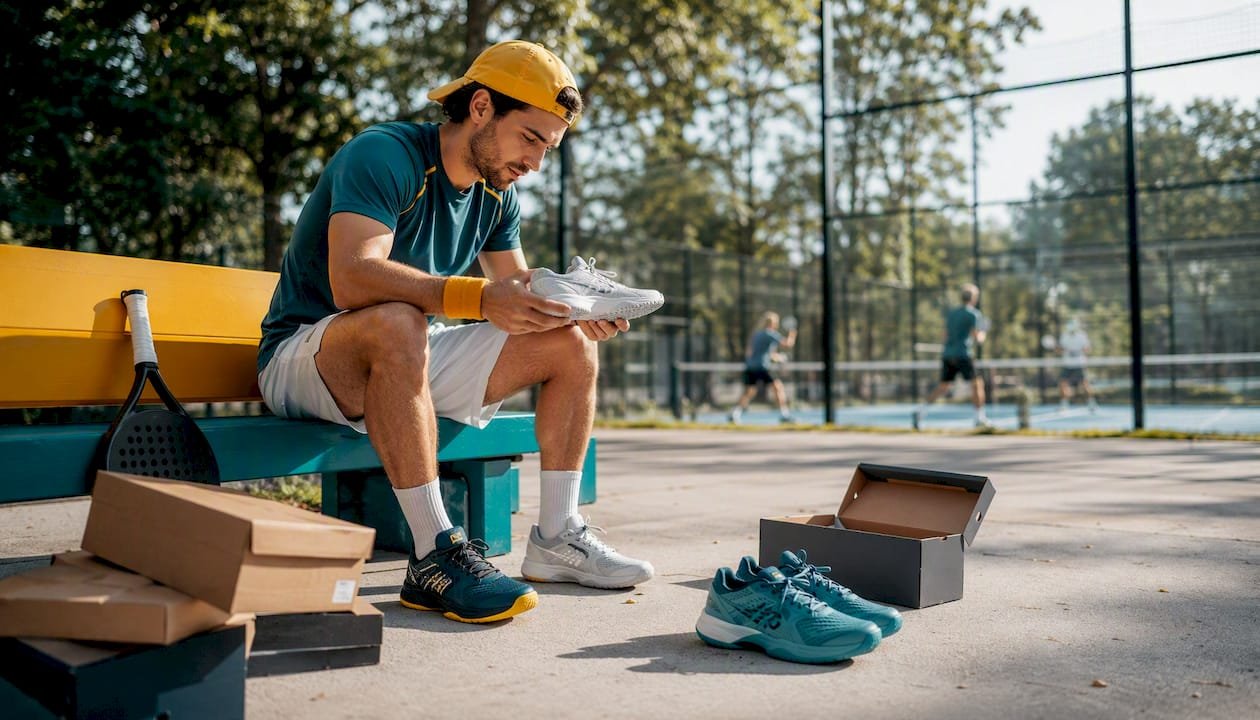
If you play padel more than once, wear padel shoes. Tennis shoes work for a single trial session, but once you’re playing weekly, the difference in grip, lateral support, and injury risk becomes real enough to matter.
Here’s the short version:
- Buy padel shoes if you play weekly, compete, or use sliding techniques on sand-infilled artificial grass
- Tennis shoes are acceptable for a one-time trial or the occasional casual game, especially if you own clay-court shoes with a herringbone sole
- Never use running shoes for padel — they lack the lateral structure the sport demands
- Padelhip carries curated padel shoe picks from Bullpadel, Babolat, Joma, and Aca Padel, all of which are available with fast shipping and easy returns
Table of Contents
- How do padel shoes and tennis shoes actually compare?
- Why padel outsoles are built differently
- How lateral support protects you on court
- Cushioning, flexibility, and weight on a padel court
- Fit and sizing guidance for padel movement
- Can you play padel with tennis shoes?
- How to choose padel shoes: features, budget, and red flags
- Padelhip picks: real padel shoe examples and who they’re for
- Key Takeaways
- The shoe choice most players get wrong
- Padelhip has the padel shoes you need, ready to ship
- Sources and further reading
How do padel shoes and tennis shoes actually compare?
The table below maps the key technical differences so you can scan specs when shopping.
| Dimension | Padel shoes | Tennis shoes |
|---|---|---|
| Grip / outsole pattern | Herringbone, fishbone, omni, or dot hybrid — optimized for sand-infilled artificial grass | Hard-court durability compound; clay-court herringbone is the closest match |
| Lateral support / reinforcement | Reinforced lateral edge, wider base, TPU shank or chassis | Varies; hard-court models often have some support, but narrower base |
| Cushioning & flexibility | Lower-profile, responsive, forefoot-flexible | More impact cushioning for longer sprints; sometimes stiffer |
| Weight | Generally lighter, built for agility | Often heavier due to extra cushioning and durability materials |
| Durability on sanded artificial grass | Excellent — compound and tread designed for the surface | Hard-court soles wear unevenly; clay soles hold up better |
| Best for | Beginner through pro padel players | Tennis players; clay-court soles acceptable short-term for padel |
| Price (U.S. market) varies depending on tier | $60–$180+ depending on type |
Quick checklist: Clay-court tennis shoes? Acceptable short-term. Hard-court tennis shoes? Use with caution. All-court or running shoes? Skip them entirely for padel.
Why padel outsoles are built differently
Most padel courts use sand-infilled artificial grass, and that surface changes how friction works under your foot. The sand sits between the grass fibers, creating a surface that rewards controlled sliding on lateral cuts rather than the dead-stop grip you’d want on a hard tennis court.
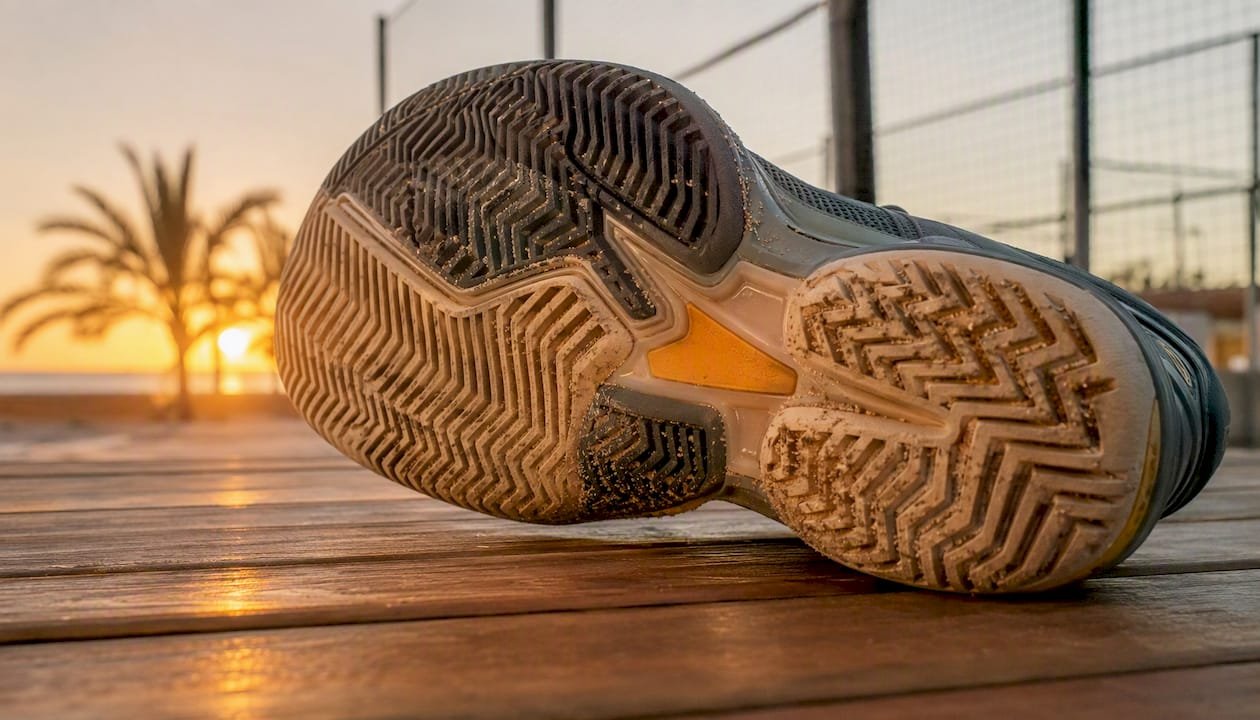
Padel-specific outsoles use herringbone (also called fishbone), omni, or dot-hybrid tread patterns. These shallower, multidirectional grooves let you slide into position during a defensive scramble and then grip for the push-off, all without catching an edge. Hard-court tennis outsoles, by contrast, are built for durability on abrasive concrete. On artificial grass, that compound can produce an unpredictable sticky-then-slip sensation during lateral moves, and it wears unevenly because the tread isn’t designed to interact with grass fibers.
Durability is the other issue. A hard-court sole used on sand-infilled turf tends to abrade faster in some spots and barely at all in others, leaving you with an uneven wear pattern that shortens the shoe’s life.
- Herringbone/fishbone: best all-around for padel, controlled slide and lateral grip
- Omni/dot hybrid: slightly more grip, less slide, suits aggressive baseline players
- Hard-court pattern: poor fit for artificial grass, causes uneven wear
- Grass studs: never use on padel courts
Pro Tip: When buying, flip the shoe and press your thumbnail into the outsole rubber. Padel-specific compounds should feel slightly softer and more pliable than the rock-hard rubber on a typical hard-court tennis shoe. Shallow, clearly defined grooves are what you want.
How lateral support protects you on court
Padel is a lateral sport. You’re changing direction constantly, decelerating hard into the corners, and pushing off at angles that put serious stress on your ankle and knee. Padel shoes address this with a reinforced lateral edge, a wider base, and often a TPU shank or chassis that stiffens the midfoot without killing forefoot flexibility.
What that structure actually does: it shifts the load path during a sharp direction change so your ankle doesn’t roll inward (inversion sprain). A narrow-based, laterally soft shoe lets the foot tip over the edge of the sole, which is exactly how ankle sprains happen. The knee absorbs the compensation forces too, so the risk isn’t just ankle-deep.
Signs a shoe lacks adequate lateral support:
- Narrow midsole that visibly tapers under the arch
- Midsole that twists easily when you hold the heel and forefoot and rotate them in opposite directions
- No visible lateral reinforcement strip or TPU overlay on the outer edge
- Heel counter that collapses when you squeeze it
Pro Tip: Before your first padel session in any new shoe, stand on one foot and do five slow lateral leans. If the shoe tips noticeably before your ankle engages, it’s not providing the lateral base padel requires.
Cushioning, flexibility, and weight on a padel court
Padel rallies are shorter and more explosive than baseline tennis exchanges. You’re rarely running long sprints; instead, you’re making quick reactive steps, short bursts, and frequent stops. That changes what you need from cushioning.
Padel shoes tend to run lower-profile and more responsive than tennis shoes. Less stack height means better court feel and faster ground reaction, which matters when you’re reading a ball off the glass wall and need to move in under a second. Tennis shoes, especially hard-court models, often carry extra cushioning for the repetitive impact of longer rallies — useful for tennis, but it can feel slightly sluggish for padel’s quick-twitch demands.
Weight is a real trade-off. Lighter shoes improve agility and reduce fatigue over a two-hour session. Heavier shoes typically offer more durability and impact protection, which matters if you’re playing four or five times a week. Most padel-specific models land in a middle range that prioritizes agility without sacrificing too much durability.
- Lower cushioning stack: better court feel, faster reaction
- Higher cushioning: more comfort for longer sessions, slightly less responsiveness
- Lighter shoe: better for agility-focused players
- Heavier shoe: better for durability and high-frequency play
Fit and sizing guidance for padel movement
Padel puts specific demands on fit that differ from tennis. The underhand serve involves a toe drag that wears the front of the shoe faster than almost any other sport-specific motion, so the toe box needs to be slightly roomier than you’d choose for running, but not so loose that the foot slides forward on lateral cuts.
The midfoot should feel snug and locked in. A loose midfoot means the foot shifts inside the shoe during direction changes, which reduces your lateral response time and increases blister risk. The heel counter should grip firmly without pinching.
Fit checklist for padel:
- Heel: no lift when you walk or jog in place
- Midfoot: feels wrapped, not compressed
- Toe box: one thumb-width of space at the longest toe
- Lateral feel: no rolling sensation when you step sideways
Sizing varies across brands. European brands like Bullpadel and Joma often run slightly narrow compared to U.S. lasts. If you’re between sizes, size up half a size for the toe-drag protection.
Pro Tip: Check the toe area after your first two sessions. If you see scuffing or wear starting on the upper near the big toe, that’s normal toe drag — but if the rubber overlay is already thinning, the shoe’s toe cap isn’t robust enough for your serve mechanics.
Can you play padel with tennis shoes?
Yes, temporarily. The honest answer is that clay-court tennis shoes with a herringbone sole are the closest safe substitute for padel shoes and can carry you through a season of casual play. They share enough tread geometry to work on sand-infilled artificial grass, though they may catch slightly more during sharp pivots.
Pros of using tennis shoes for padel:
- Convenient if you already own them
- Clay-court herringbone soles grip reasonably well on artificial grass
- Saves money for players testing the sport
Cons and risks:
- Hard-court soles grip inconsistently on artificial grass, increasing slip risk
- Narrower base and softer lateral structure raise ankle sprain risk with frequent play
- Running shoes are engineered for forward motion and lack the lateral integrity padel requires
- Faster and uneven wear on both the shoe and the court surface
Decision flow by play frequency:
- One-time trial: Clay-court or all-court tennis shoes are fine. Don’t buy padel shoes yet.
- Monthly casual play: Clay-court tennis shoes work. Monitor wear and lateral feel.
- Weekly play: Buy padel shoes. The grip, support, and durability difference is worth the cost.
- Competitive or technique-focused play: Padel shoes are non-negotiable. Sliding technique on artificial grass requires the right outsole.
Acceptable substitutes: Clay-court tennis shoes (herringbone sole)
Explicit warnings: Never use running shoes, gym trainers, or grass-stud shoes for padel.
How to choose padel shoes: features, budget, and red flags
The buying checklist
- Outsole pattern: herringbone, fishbone, or omni/dot hybrid
- Reinforced lateral edge or TPU overlay on the outer midsole
- Rubber toe cap or overlay for serve toe drag
- Midsole stiffness: firm enough to resist lateral collapse, flexible at the forefoot
- Weight: light enough for most players
- Upper: breathable mesh with reinforced overlays at high-wear zones
Price ranges for U.S. shoppers
- Entry ($60–$100): Solid outsole and basic lateral support; good for beginners and casual players
- Mid ($100–$140): Better lateral reinforcement, more durable toe cap, improved fit systems
- Premium ($140–$180+): Advanced outsole compounds (e.g., Vibram), carbon or TPU chassis, pro-level durability
Questions to ask before buying
- What outsole compound is used, and is it rated for artificial grass?
- Does the last run narrow or wide?
- Is there a reinforced toe cap?
Care tips
Rotate between two pairs if you play three or more times a week. After each session, knock sand out of the outsole grooves with a stiff brush. Replace the shoes when the herringbone ridges have worn flat — that’s when grip drops noticeably.
Red flags: No outsole pattern listed in the specs, no mention of a reinforced toe, vague sizing guidance with no last-width information.
Pro Tip: Sand from the court packs into outsole grooves and acts like sandpaper on the rubber compound. A 30-second brush-out after every session can add months to a shoe’s life.
Padelhip picks: real padel shoe examples and who they’re for
Bullpadel Vertex Vibram 25I
- Vibram outsole compound delivers exceptional grip and durability on sand-infilled artificial grass
- Reinforced lateral chassis and a firm midsole built for explosive direction changes
Best for: Intermediate to advanced players who play weekly and want a shoe that holds up under high-frequency use. Premium tier.
Babolat Jet Viva M
- Lightweight construction prioritizes agility without sacrificing lateral structure
- Herringbone outsole pattern performs well on artificial grass for beginners learning court movement
Best for: Beginners and recreational players stepping up from tennis shoes for the first time. Entry to mid tier.
Joma Master 1000 Lady 2502
- Women-specific last with a snug midfoot fit and reinforced toe cap for serve toe drag
- Durable outsole compound rated for artificial grass with solid lateral edge support
Best for: Women players at beginner to intermediate level who want a purpose-built padel shoe with a proper fit. Mid tier.
Aca Padel Magic White
- Clean, versatile design with an omni-pattern outsole that handles both grip and controlled sliding
- Accessible price point makes it an easy upgrade from tennis shoes for players committing to the sport
Best for: Men at beginner to intermediate level who want a reliable padel shoe without a premium price tag. Entry to mid tier.
Key Takeaways
Padel shoes outperform tennis shoes on artificial grass courts in grip, lateral support, and durability, making them the right choice for any player who steps on court more than once or twice.
| Point | Details |
|---|---|
| Outsole pattern is the core difference | Herringbone and omni soles grip sand-infilled artificial grass; hard-court soles wear unevenly and grip inconsistently. |
| Lateral support reduces injury risk | Reinforced edges and wider bases lower ankle inversion risk during padel’s frequent direction changes. |
| Clay-court tennis shoes are the best substitute | If you already own herringbone-soled tennis shoes, they’re an acceptable short-term option for casual play. |
| Never use running shoes for padel | Running shoes lack lateral structural integrity and substantially increase ankle sprain risk on padel courts. |
| Padelhip curated picks | Bullpadel, Babolat, Joma, and Aca Padel models are available at Padelhip with fast shipping and easy returns. |
The shoe choice most players get wrong
Most players upgrading from tennis to padel focus on the racket and treat the shoe as an afterthought. That’s the wrong order of priorities. Footwear is the only piece of equipment that directly mediates every movement you make on court, and padel’s lateral demands are different enough from tennis that the wrong shoe genuinely changes your injury exposure, not just your comfort level.
The conventional wisdom that “any court shoe will do” holds up for exactly one session. After that, the grip inconsistency on artificial grass, the lateral instability of a narrow-based tennis shoe, and the faster-than-expected wear pattern all become noticeable. The players who stick with padel long-term tend to make the shoe switch early, not because they were told to, but because they felt the difference themselves.
Padelhip’s selection covers the full range from entry-level to pro, with 100% authentic products, easy returns, and fast worldwide shipping, so there’s no reason to delay the upgrade once you know you’re playing regularly.
Padelhip has the padel shoes you need, ready to ship
The four models covered above are just the starting point. Padelhip carries a curated selection of padel-specific footwear from Bullpadel, Babolat, Joma, and Aca Padel, all verified authentic and priced competitively across entry, mid, and premium tiers.
Every order ships fast with easy returns, so if the fit isn’t right, the process to exchange is straightforward. You can check shipping details and delivery options before you buy. Browse the full shoe selection at Padelhip, pick the model that matches your play frequency and budget, and get the right footwear on court before your next session.
Sources and further reading
- Padel Shoes vs Tennis Shoes: What Is the Difference? — PadelRevive — supports outsole pattern claims and hard-court compound drawbacks on artificial grass
- Padel Shoes vs Tennis Shoes: Can You Use Tennis Shoes? — PadelSetup — supports clay-court substitute guidance, running shoe warnings, and weekly-play recommendation
- Padel shoes: sole types, price points, and what club players need — Padel Underground — supports lateral support design, toe cap details, and cushioning comparisons
- Comparing Padel Shoes and Tennis Shoes — Wilson Australia — supports expert-backed statements on sport-specific footwear and agility
- Padel Shoes vs. Tennis Shoes: The Ultimate Guide — Wilson US — additional reference on footwear design differences
- Can you play padel with tennis shoes? — PadelUSA — U.S.-market perspective on shoe substitution
- Padel Shoes vs Tennis Shoes — Midwest Racquet Sports — additional U.S.-market comparison reference
Recommended
- Babolat Jet Viva M 26 Padel Shoes | Lightweight Comfort & Grip Shoes for Beginner and Intermediate Players – Your online Padel store- Padel Hip-Premier padel shop
- Bullpadel Vertex Vibram 25I Padel Shoes – Pro Stability & Grip – Your online Padel store- Padel Hip-Premier padel shop
- Choosing the Right Padel Racket Shape: A Complete Guide – Your online Padel store- Padel Hip-Premier padel shop
- Aca Padel Magic White Padel Shoes for Men – Your online Padel store- Padel Hip-Premier padel shop