Best Beginner Padel Rackets: Top Picks for 2026

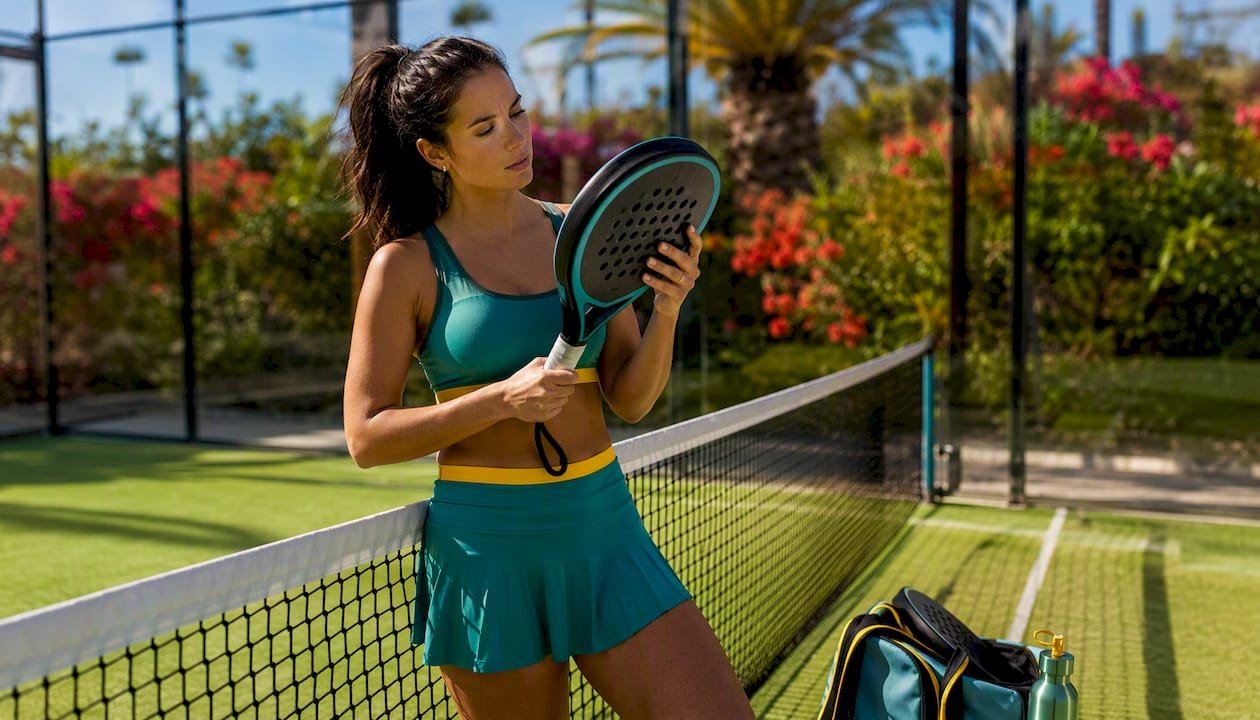
For most new players, the right starting point is a round-head racket with a soft EVA core and a suitable beginner-friendly weight. Three models stand out in 2026: the Adidas Match Black/Lime (best overall control), the Bullpadel Indiga CTR 26 (most forgiving sweet spot), and the ACA Roqueta (lightest and easiest to maneuver). Buy from a seller who guarantees authenticity and accepts returns, like Padelhip, or ask your local court if you can demo before committing. Renting is fine for a single session, but gear testers and coaches consistently find that venue rentals are often heavy and inconsistent, which slows down skill development fast.
Table of Contents
- How do the best beginner padel rackets compare?
- What makes a good beginner padel racket?
- The best beginner padel rackets: short profiles
- How do you choose your first padel racket?
- Is buying your first racket better than renting?
- Key Takeaways
- Why Padelhip curates these beginner models
- The right place to buy your first padel racket
How do the best beginner padel rackets compare?
The table below covers every model on the shortlist across the specs that matter when you’re starting out.
| Model | Best for | Shape | Weight | Balance | Core | Face/Frame | Price range | Who it fits |
|---|---|---|---|---|---|---|---|---|
| Adidas Match Black/Lime 2026 | Control + value | Round | Beginner-appropriate | Even/handle | Soft EVA | Fiberglass | $$ | Most beginners |
| Adidas Match Black/Orange 2026 | Control + style | Round | Beginner-appropriate | Even/handle | Soft EVA | Fiberglass | $$ | Most beginners |
| Bullpadel Indiga CTR 26 | Forgiveness | Round | Beginner-appropriate | Handle-biased | Soft EVA | Fiberglass | $$ | Players prone to mishits |
| ACA Roqueta | Maneuverability | Round | Lightweight | Handle-biased | Soft EVA | Fiberglass | $$ | Lighter players, women |
| Adidas Drive Black 2026 | Control + durability | Round | Suitable for casual to regular players | Even | Soft Performance EVA | Fiberglass | $$ | Casual to regular players |
| Wilson Optix V2 | Lightweight feel | Round | Suitable for budget-conscious beginners | Even | Soft EVA | Fiberglass | $ | Budget-conscious beginners |
| NOX ML10 Pro Cup | Control + brand upgrade | Teardrop | Slightly heavier than beginner norms | Even | Soft EVA | Fiberglass/carbon | $$$ | Committed beginners ready to invest |
Price range key: Price categories span from budget to premium tiers.
For US buyers, expect to pay within an entry-level price range for solid rackets. Models at the low end of the market often use lower-density foam that may degrade quickly, while midrange options generally offer good durability and quality suitable for regular play.
What makes a good beginner padel racket?
The four specs below separate a genuinely beginner-friendly racket from one that just looks the part on a product page.
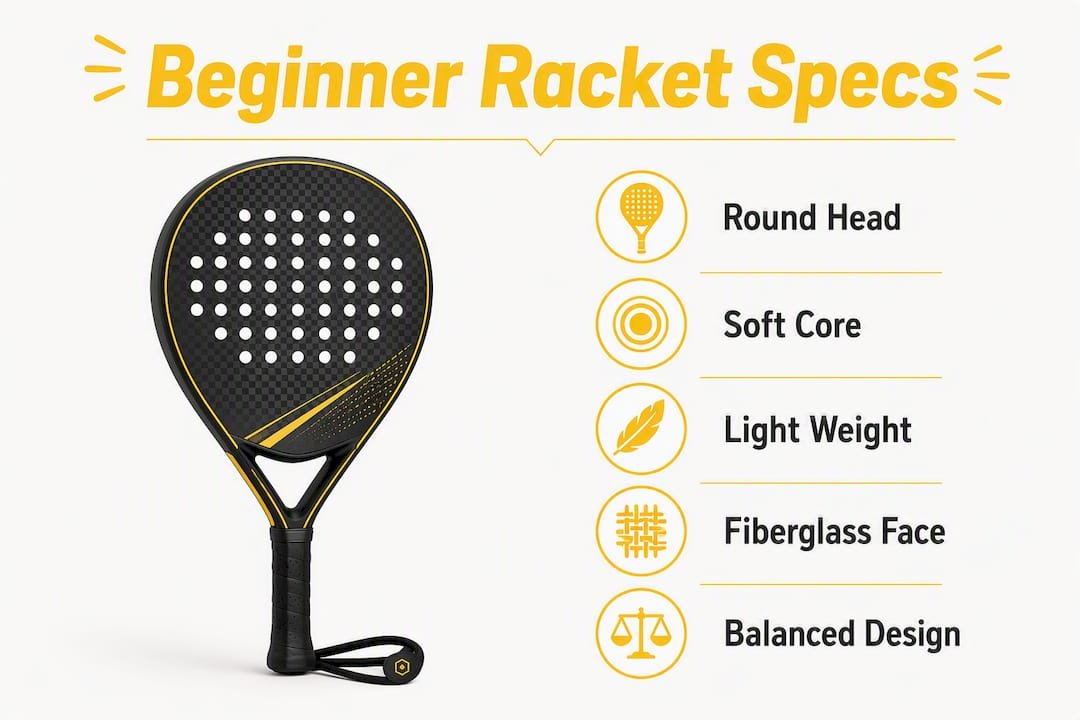
Shape: round wins every time. A round head places the sweet spot lower on the face, right where new players naturally make contact. Round-shaped rackets forgive off-center hits far better than teardrop or diamond frames, which demand precise contact that takes months to develop. Coaches consistently warn that beginners who grab a diamond-shaped “power” racket too early slow their own technical progress because the frame punishes every mishit.
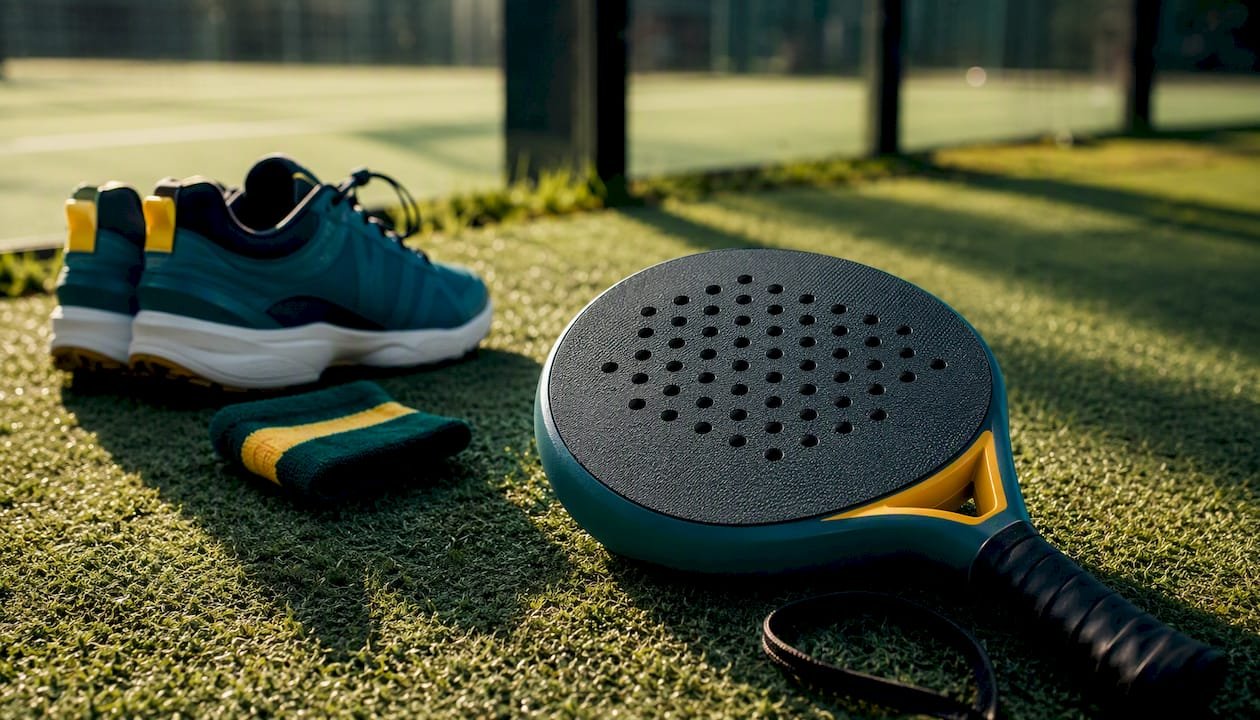
Weight: 360–380 g is the optimal target range. Heavier rackets increase arm and wrist strain, especially on mishits. PadelRevive recommends a round-shaped, soft-core racket in the 360–380 g range as the optimal beginner profile, and most coaches agree the lower end of that band is safer for players who are new to the swing mechanics.
Core: soft EVA, not hard. Soft EVA cores absorb vibration and increase the effective sweet spot, which is exactly what you need when your contact point is still inconsistent. Hard cores transfer more shock to the arm and are designed for players who already hit the center consistently.
Face material: fiberglass over carbon. Fiberglass flexes slightly on impact, adding a natural dampening effect. Carbon is stiffer and more powerful, but that stiffness punishes off-center hits. For beginners, fiberglass is the safer, more forgiving choice.
Grip and overgrip. Most rackets ship with a grip circumference of 4¼ inches (L2). If your hand is small, wrap an overgrip to fine-tune the feel rather than buying a different size. A grip that’s too thin causes the racket to rotate on contact.
Selection checklist before you buy:
- Round head shape confirmed in the product specs
- Weight listed in the 360–380 g range
- Core described as soft EVA (not “performance foam” without further detail)
- Face material listed as fiberglass (not full carbon)
- Seller offers returns within at least 14 days
Pro Tip: If you play outdoors in cooler weather, the same foam core will feel noticeably stiffer than it does indoors. Players who regularly play outside in fall or winter should lean toward the softest available EVA and keep the racket weight at the low end of the 360–380 g range to avoid added shock on mishits.
Most players are ready to upgrade after 12–18 months of regular play. The signal isn’t time, though. It’s when you’re consistently hitting the sweet spot and starting to want more spin or reach on your shots.
The best beginner padel rackets: short profiles
Adidas Match Black/Lime 2026
The Adidas Match Black/Lime is the closest thing to a consensus pick for new players. Round shape, soft EVA core, fiberglass face, and a weight in the 355–365 g range. It handles mishits without punishing your elbow, and the balance sits even to slightly handle-biased, which makes it easy to swing through the ball without fighting the weight. Available at Padelhip with authenticity guarantee and easy returns. Best for: most beginners who want one reliable racket and don’t want to overthink it.
Adidas Match Black/Orange 2026
Functionally identical to the Lime version, the Adidas Match Black/Orange shares the same round shape, soft EVA core, and fiberglass construction. The difference is purely cosmetic. If you’re buying for a partner or want a second racket for a guest, this is the obvious companion pick. Same beginner-friendly specs, same price range, same availability through Padelhip.
Bullpadel Indiga CTR 26
The Bullpadel Indiga CTR 26 is built around one idea: maximum forgiveness. The round head and handle-biased balance keep the swing weight low, and the soft EVA core absorbs more vibration than most rackets in this price range. Reviewers consistently list it among the top beginner options for players who struggle with arm soreness or who mishit frequently. The “CTR” designation stands for control, and it earns it. If you’ve had elbow issues with other rackets or sports, start here.
ACA Roqueta
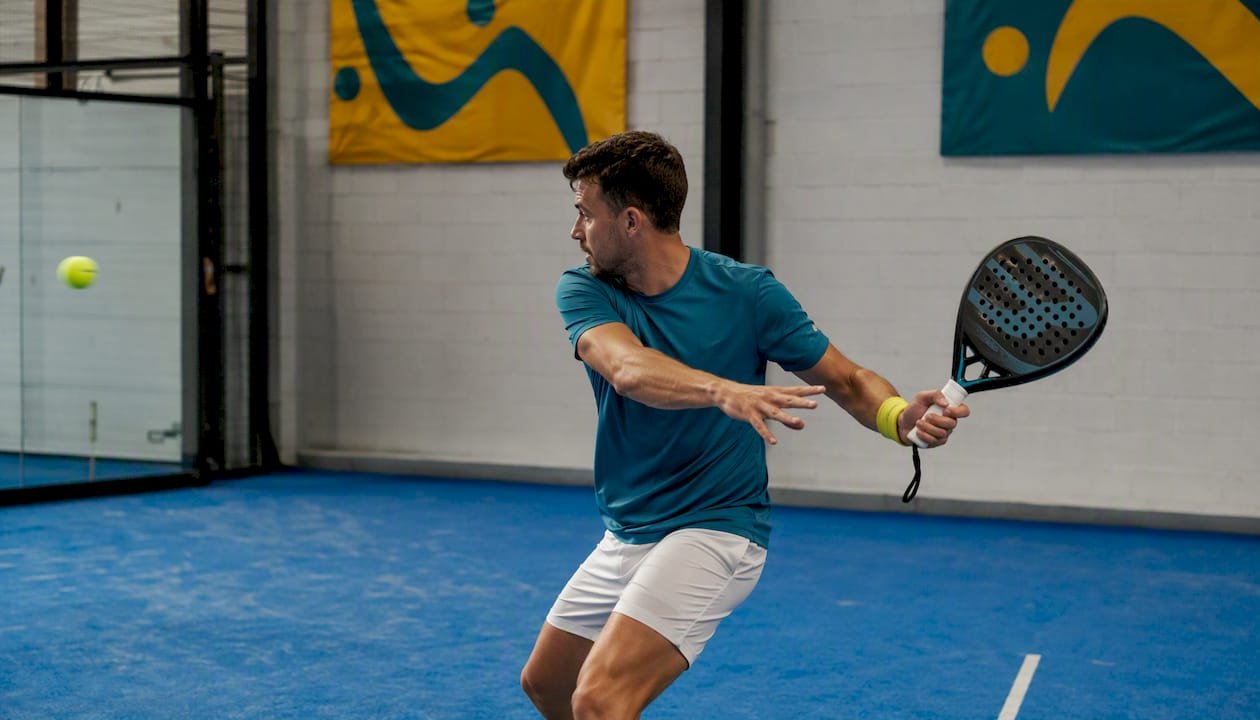
The ACA Roqueta is the lightest model on this list, typically landing in the 340–355 g range. That low weight makes it exceptionally easy to maneuver, which matters most for players with smaller frames, women new to the sport, or anyone who finds a heavier racket tiring after a few games. The trade-off is slightly less stability on hard shots, but at the beginner stage that’s rarely a problem. Padelhip stocks it as a lightweight control option with fiberglass construction.
Adidas Drive Black 2026
Adidas positions the Drive as a dedicated beginner model, and the specs back that up: round shape, Soft Performance EVA core, fiberglass face, and a 360–375 g weight band. The sweet spot sits at center, which matches where most new players make contact. It’s slightly heavier than the Match variants, so players who are sensitive to arm fatigue should try it before committing. For casual players who get on court once or twice a week, the Drive’s durability makes it a strong long-term value.
Wilson Optix V2
The Wilson Optix V2 sits at the budget end of the shortlist, typically under $80. Round shape, soft EVA core, and a weight in the 350–365 g range. It’s not the most refined racket here, but for someone who wants to try padel without spending over $100, it’s a sensible starting point. The fiberglass face keeps it forgiving, and Wilson’s build quality holds up reasonably well for casual use. Don’t expect it to last 18 months of intensive play, but for a few sessions a week it does the job.
NOX ML10 Pro Cup
The NOX ML10 Pro Cup is the most advanced racket on this list. It uses a teardrop shape rather than round, which means a slightly smaller sweet spot and a touch more power on centered shots. The soft EVA core and fiberglass/carbon hybrid frame keep it accessible, but it rewards players who already have some consistency in their swing.
Who should choose the NOX ML10 Pro Cup: players who are new to padel but come from a tennis or squash background, have strong hand-eye coordination, and want a racket they won’t outgrow in six months. It’s not the most forgiving option here, but it’s the one with the most room to grow into.
How do you choose your first padel racket?
Follow these steps in order and you’ll avoid the most common beginner mistakes.
-
Set your budget before you look at anything else. Decide on a ceiling: under $80, $80–$140, or up to $200. This immediately narrows the field and stops you from being upsold into a racket that’s wrong for your level.
-
Confirm the four required specs on the product page. Round shape. Weight in the 360–380 g range. Soft EVA core. Fiberglass face. If any of these four are missing or unclear, skip that model.
-
Ask about a demo. Many padel clubs in the US let you borrow a racket for a session, or they have demo days. Swing the racket for at least 15 minutes before deciding. Pay attention to how it feels on mishits, not just clean shots.
-
Check the return policy before you buy online. A reputable seller will offer at least 14 days. If the return window is shorter or unclear, that’s a red flag.
-
Verify the warranty. Most rackets in the $80–$160 range carry a 3–6 month manufacturer warranty. Anything with no stated warranty is a risk.
Questions to ask when demoing:
- Does the racket feel heavy after 10 minutes of play?
- Do mishits send vibration up into your wrist or elbow?
- Can you swing it quickly without fighting the weight?
Red flags that should stop a purchase:
- The product listing emphasizes “power” or “spin” without mentioning control or forgiveness
- Core material is listed as “performance foam” with no further detail
- Weight is above 375 g
- No return policy is stated
A quick 30-second on-court test: hit 10 balls from the baseline, including a few intentional mishits toward the frame edge. If the vibration on those off-center hits is uncomfortable, the racket is too stiff or too heavy for you. A good beginner racket should feel almost forgiving even when you miss.
Is buying your first racket better than renting?
Yes, almost always. Rental rackets at padel venues are frequently heavy, worn, and inconsistent in weight and feel. Playing with a different racket every session makes it genuinely hard to build the muscle memory that early skill development depends on.
Gear testers and coaches agree: rental rackets are commonly heavy and low-quality. Investing in a consistent beginner racket early helps build reliable muscle memory and prevents misleading feel from session to session.
The cost math is straightforward. Rental fees at US padel clubs typically run $5–$15 per session. A solid beginner racket costs $80–$140 and lasts 12–18 months of regular play. If you play twice a week, you break even on the racket cost within two to three months. After that, every session is effectively free on equipment.
The Guardian’s racket testing makes the same point: renting is fine when you’re genuinely trying padel for the first time, but once you’ve decided you like the sport, buying is the sensible move.
When renting makes sense:
- Your first one or two sessions, before you know if you’ll stick with the sport
- Traveling and you don’t want to bring your racket
When buying is the right call:
- You’ve played two or more times and plan to continue
- You’re experiencing arm or wrist discomfort from heavy rental rackets (a soft-core, sub-365 g racket reduces this risk significantly)
- You want to track your own improvement with consistent equipment
Key Takeaways
For beginners, the single most important decision is choosing a round-head, soft EVA core racket with a suitable weight that protects your arm and gives you the largest possible sweet spot while your technique develops.
| Point | Details |
|---|---|
| Shape and core matter most | Round head plus soft EVA core gives the largest sweet spot and best vibration absorption for new players. |
| Stay in the 360–380 g range | Rackets above 380 g increase arm and wrist strain; the lower end of the 360–380 g band is safest for beginners. |
| Budget $80–$140 for a solid starter | This range gets you proper soft EVA construction and a fiberglass face that lasts 12–18 months of regular play. |
| Buy rather than rent | Rental rackets are often heavy and inconsistent; owning one racket builds muscle memory faster and costs less within months. |
| Padelhip stocks the top picks | The Adidas Match, Bullpadel Indiga CTR 26, and ACA Roqueta are all available at Padelhip with authenticity guarantee and easy returns. |
Why Padelhip curates these beginner models
Most of the rackets I see beginners buy online are wrong for them. Not because they’re bad rackets, but because the product page doesn’t tell you what actually matters: how the foam feels after 30 minutes of play, whether the weight is going to tire your arm, or whether the frame will hold up after a few months of regular use.
The models on this list were chosen because they consistently deliver on the specs that protect new players: soft cores, forgiving faces, and weights that don’t punish you for imperfect technique. That’s not a marketing claim. It’s what the coaching community and gear testers keep coming back to, and it’s the filter Padelhip applies when deciding which beginner rackets to stock.
What most beginner guides miss is the arm-health angle. Elbow and wrist soreness is one of the most common reasons new players quit padel in the first three months. A racket that’s too stiff or too heavy is usually the cause, not the player’s technique. Choosing a soft-core, handle-balanced racket in the right weight range is the single most effective way to avoid that outcome.
Padelhip ships worldwide, offers easy returns, and guarantees every racket is 100% authentic. For US players, that matters: the padel gear market has a counterfeit problem, and buying from a verified retailer is the only way to be sure you’re getting the specs the product page promises.
The right place to buy your first padel racket
Padelhip carries every model on this shortlist, including the Adidas Match Black/Lime, the Bullpadel Indiga CTR 26, and the ACA Roqueta, all with authenticity guarantees and straightforward returns. Every racket ships directly from Spain with fast worldwide delivery, so US buyers get the same authentic gear that players in Europe are buying. No gray-market risk, no guessing about specs.
If you’re not sure which model fits you, the Padelhip store includes detailed spec breakdowns for each racket, and the team is available to answer questions before you buy. Returns are easy if the racket doesn’t feel right once it arrives.
For US beginners ready to commit to padel, this is the most straightforward path to a racket you can trust: authentic gear, clear specs, and a seller who stands behind what they ship. Browse the full beginner racket selection at Padelhip and pick the model that matches your weight preference and budget.
Recommended
- ACA Roqueta Padel Racket 2026 – Lightweight Control Racket for Beginners – Your online Padel store- Padel Hip-Premier padel shop
- Adidas Match Black/Lime 2026 Padel Racket for Beginner Players – Lightweight Fiberglass All-Round Racquet with Soft EVA Core and Large Sweet Spot – Your online Padel store- Padel Hip-Premier padel shop
- Adidas Arrow Hit Junior Pink/Blue 2026 Padel Racket for Kids – Lightweight Junior Racquet with Soft Foam Core and Easy Control for Beginners – Your online Padel store- Padel Hip-Premier padel shop
- Adidas Match Black/Orange 2026 Padel Racket for Beginner Players with Lightweight Fiberglass Frame and Soft EVA Core for Easy Control and Comfort – Your online Padel store- Padel Hip-Premier padel shop