

Are Indoor and Outdoor Padel Balls Actually Different?

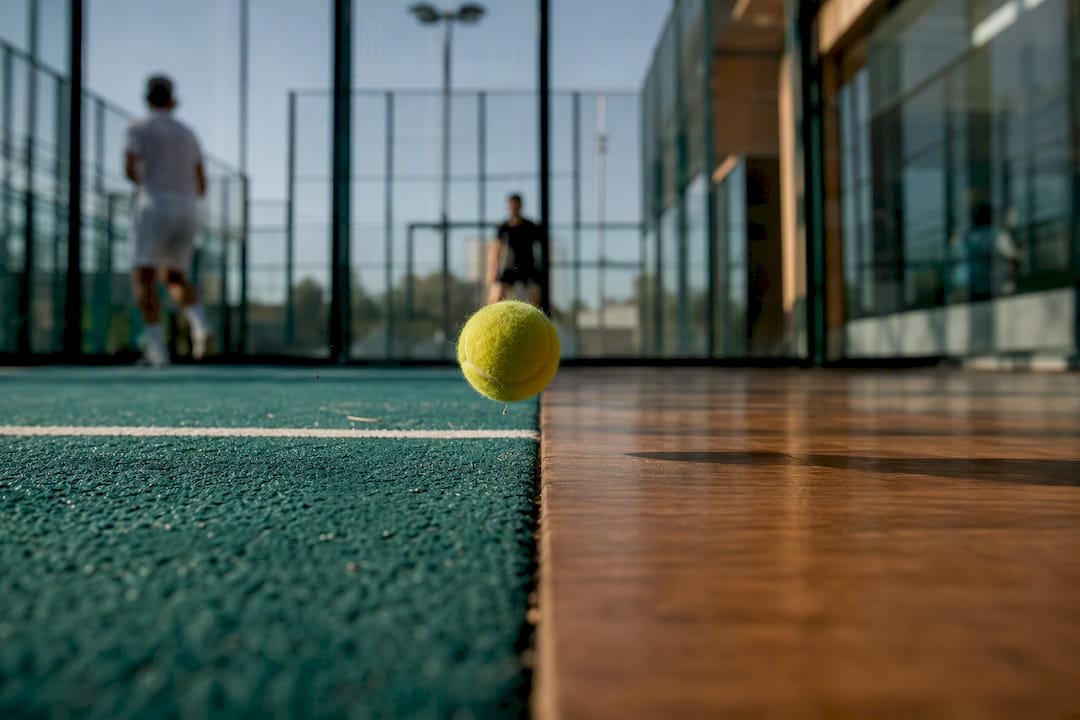
There aren’t separate indoor and outdoor padel balls. Every ball approved for competition follows the same FIP technical specifications regardless of where you play. What changes is how that ball behaves once temperature, humidity, wind, and court surface get involved.
For matches, buy FIP-approved pressurized cans and treat them as consumables. For practice, drills, or ball machine sessions, pressureless balls save money and last far longer. If you split your week between an indoor club and an outdoor court, keep both types in your bag.
- Matches (indoor or outdoor): FIP-approved pressurized balls, opened fresh each session
- Coaching and ball machine drills: pressureless balls
- Cold or slow courts: consider “fast” balls for extra bounce
- Hot or already-fast outdoor courts: stick with regular-speed balls
Key Takeaways
Indoor and outdoor padel balls are the same FIP-approved product; environment, not the ball itself, determines how they perform and how long they last.
| Point | Details |
|---|---|
| Same ball, different conditions | Temperature, humidity, wind, and surface change bounce and feel, not the ball’s specs. |
| Know the FIP window | Legal balls fall between 6.35–6.77 cm, 56.0–59.4 g, with 135–145 cm standard bounce. |
| Match pressurized, drill pressureless | Pressurized cans last 2–4 hours of play; pressureless balls last months for coaching and machines. |
| Test before you trust | Use the two-lob swing test to catch pressure loss before it costs you a match. |
| Store smart | Keep cans cool, dry, and out of hot cars to slow gas loss and felt wear. |
| Shop the right mix | Padelhip stocks FIP-approved match cans and pressureless training balls with an authenticity guarantee and easy returns. |
Table of Contents
- Indoor vs Outdoor Padel Ball Performance: What Changes on Court
- FIP Ball Specs, Pressurized vs Pressureless, and What “Fast” Means
- Choosing the Right Ball Setup When You Play Both Courts
- How to Store Padel Balls So They Last Longer
- Why Outdoor Balls Wear Out Faster Than Indoor Ones
- What Sun and Weather Do to an Outdoor Padel Ball
- Felt Texture and Core Differences Players Actually Notice
- Frequently Asked Questions
- Sources
Indoor vs Outdoor Padel Ball Performance: What Changes on Court
The ball itself doesn’t change. The air around it does, and that’s what alters how it plays.
Heat speeds everything up. Warm air expands the gas inside a pressurized ball, so it bounces higher and travels faster off the strings. Drop the temperature and the opposite happens: the ball compresses slightly, feels duller, and sits lower off the wall. That’s why a ball fresh off an outdoor court in August plays nothing like the same brand on a chilly November evening.
Humidity adds a second variable. Moisture in the air gets absorbed by the felt, and a damp ball feels heavier and grips the strings differently on contact. Indoor clubs sidestep this almost entirely, since climate control keeps humidity fairly constant. Outdoors, you’re at the mercy of the forecast.
Wind is the outdoor-only wildcard. It doesn’t just push shots off-line. It also cools the ball’s surface unevenly and makes bounce prediction harder on lobs, which is why outdoor rallies tend to feel scrappier even between good players.
Court surface plays a bigger role than most players expect. According to research on indoor vs outdoor padel equipment, dust and sand on outdoor turf change both bounce consistency and how fast the felt wears down, while a clean indoor surface keeps the ball’s response far more predictable session to session.
- Warm courts: expect a livelier, higher bounce
- Cold courts: expect a flatter, slower response
- Humid air: expect a heavier-feeling ball with less pop
- Sandy or dusty outdoor turf: expect faster felt wear and less predictable bounce
If your indoor club runs cold in winter, a “fast” ball can restore the bounce you’re used to. If you’re outdoors on a hot, already-fast court, a regular-speed ball keeps rallies from turning into a serve-and-smash contest.
FIP Ball Specs, Pressurized vs Pressureless, and What “Fast” Means
Every ball legal for sanctioned play has to sit inside a narrow technical window. The FIP’s 2025 approval document sets diameter at 6.35 to 6.77 cm, weight at 56.0 to 59.4 grams, standard bounce between 135 and 145 cm, and internal pressure between 4.6 and 5.2 kg per 2.54 cm². Courts above roughly 1,000 meters in altitude use a separate, higher bounce range, since thinner air changes how far a ball rebounds.
Tournament organizers are required to name the approved ball brand and model in advance, so if you’re prepping for a sanctioned event, check that specific model before you buy a case.
Beyond specs, the real choice most players face is pressurized versus pressureless:
- Pressurized balls deliver a lively, controlled bounce and are what you’ll find inside sealed match cans. They typically hold that performance for 2 to 4 hours of play before losing enough pressure to feel noticeably flat.
- Pressureless balls use a denser rubber core instead of compressed gas. They start slightly heavier and less lively but stay consistent for months, which makes them the practical pick for ball machines, solo drills, or high-volume coaching.
“Fast” and “regular” balls refer to how quickly they come off the strings. Fast balls suit cold, slow courts where you need extra pop; regular balls suit warm, already-fast conditions where you don’t want the ball running away from you.
| Ball Type | Typical Lifespan | Best Use |
|---|---|---|
| Pressurized (match) | 2–4 hours of play | Competitive matches, league play |
| Pressureless (training) | Several months | Ball machines, coaching, solo drills |
| Fast pressurized | 2–4 hours of play | Cold indoor courts, slow outdoor surfaces |
Once you crack open a can, the clock starts. Even sealed but unused, opened cans lose gas over time simply from atmospheric pressure differences, a pattern confirmed by independent lab testing from Testfakta that also found meaningful differences between brands in how fast they lose bounce and felt quality. Don’t assume a familiar logo guarantees consistent durability; testing a few different cans is worth the modest cost.
Choosing the Right Ball Setup When You Play Both Courts
Most players overcomplicate this. It really comes down to three questions: what are you doing today, how fast is the court, and how do you know when a ball is done?
- Start with the purpose. Competitive match, league night, or club tournament? Grab a fresh FIP-approved pressurized can. Coaching session or ball machine work? Pressureless balls handle the volume without the constant replacement cost.
- Match the ball speed to the court. A cold indoor hall in winter or a shaded outdoor court in early spring often plays slow, so a “fast” ball keeps the game lively. A hot afternoon outdoors, especially on a fast synthetic surface, calls for a regular-speed ball so rallies don’t turn into pure power contests.
- Test before you trust. The simplest field check is the two-lob method: hit two lobs with an identical swing. If the second one falls noticeably shorter, you’re compensating for lost pressure, and the ball needs replacing.
- Buy at the right scale. Solo or casual players do fine with single cans bought as needed. Clubs and coaches running multiple sessions a week save money buying pressurized cans and pressureless balls in bulk packs, since balancing premium match cans with pressureless training stock is the most cost-effective setup for high-throughput play.
If you’re building out a starter kit alongside your ball choice, it’s worth pairing this with a look at beginner padel rackets, since racket flex and ball speed interact more than most new players expect.
Pro Tip: Keep one “fresh” can specifically for matches and never use it for warmups. Warming up with an already-broken-in ball, then switching to a new one for the actual match, throws off your timing right when you need it most.
How to Store Padel Balls So They Last Longer
Storage habits matter more than most players think, and the fixes cost nothing.
Unopened cans hold pressure well as long as they stay cool and out of direct sunlight. Opened cans are a different story. They start losing gas the moment the seal breaks, and heat accelerates that loss dramatically, which is exactly why leaving a can in a hot car is one of the fastest ways to kill a set of balls before you’ve even played with them twice.
- Store unopened cans in a cool, dry cupboard, not a garage or car boot
- Use opened cans within a couple of weeks for anything approaching match intensity
- Keep pressurized cans away from direct sun between sessions, even courtside
- Rotate older cans into practice duty once they start feeling flat for matches
A pressuriser tube can extend a can’s life by restoring lost pressure between sessions, and it’s worth the investment for players going through several cans a month. For occasional weekend players, it’s overkill.
Outdoor heat doesn’t just affect balls. It cooks rackets left in direct sun and grips that are already worn thin, so if you’re regularly outdoors, check your grip more often than you would indoors, and consider a bag with thermal protection for hot-weather sessions.
Pro Tip: Never store a pressurized can and a pressureless ball in the same compartment long term. Pressureless balls can pick up dust and grit that transfers onto felt during travel, accelerating wear on both.
Why Outdoor Balls Wear Out Faster Than Indoor Ones
Durability is where the indoor and outdoor gap shows up most clearly, even though the ball itself is identical off the shelf.
Indoor courts offer a controlled surface: consistent temperature, no dust, no sand, no UV exposure. A ball played exclusively indoors tends to hold its bounce and felt integrity closer to its full lifespan window, since nothing outside the ball’s own gas loss is working against it.
Outdoor courts introduce abrasion that indoor courts simply don’t have. Sand and dust embedded in artificial turf grind against the felt on every bounce, and that friction wears down the fuzzy exterior faster than clean indoor surfaces do. Once the felt thins, the ball grips the racket differently and loses some of its bite on slice shots.
Heat compounds the problem. A pressurized ball played outdoors on a 30 degree Celsius afternoon experiences more gas expansion and contraction over a session than the same ball played in a stable indoor environment, and repeated heat cycling shortens its useful life. Coaches who split their week between indoor and outdoor sessions often notice they get more total playing hours per can indoors, simply because the ball isn’t fighting the surface and the temperature at the same time.
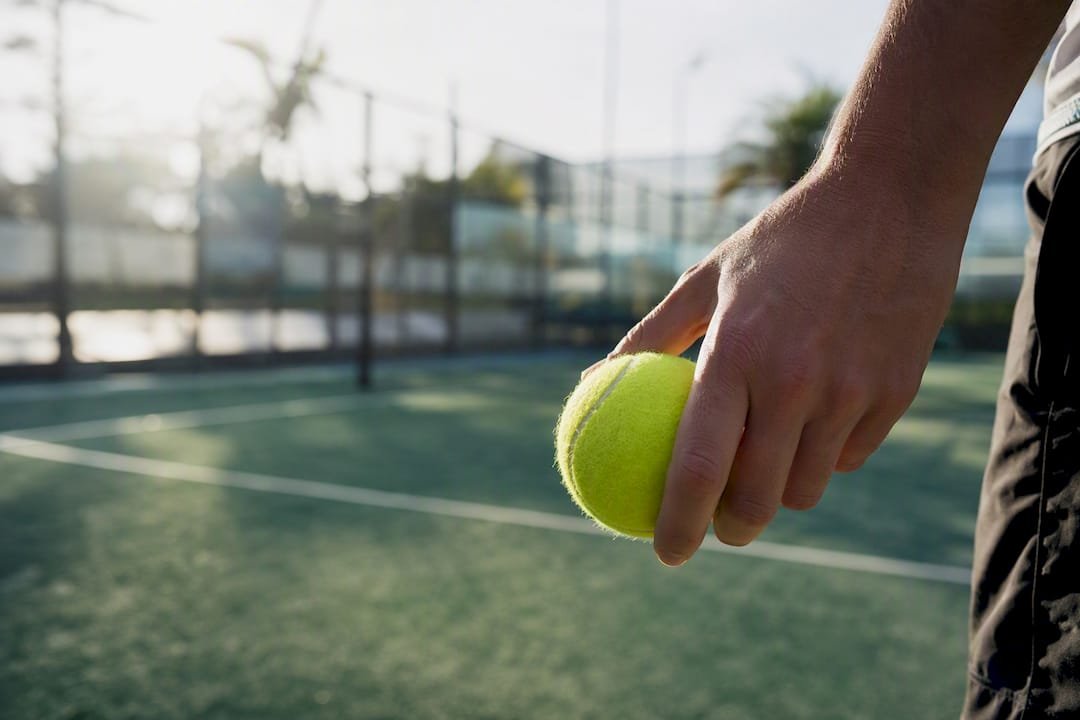
Practically, this means outdoor players should expect to replace cans somewhat more often during peak summer heat, and should not be surprised if a ball that felt fine after two indoor sessions is noticeably duller after one outdoor session in strong sun.
What Sun and Weather Do to an Outdoor Padel Ball
UV exposure is the quiet killer of outdoor equipment, and it affects balls in a way that isn’t always obvious mid-session.
Prolonged sun exposure breaks down the rubber compound inside a ball over time, making it more brittle and less elastic than a ball kept out of direct light. Combined with heat, this accelerates the felt degradation that outdoor play already causes through surface friction. A ball left sitting courtside in full sun between sets is aging faster than one kept in shade or in a bag.
Weather beyond sun matters too. Damp conditions, whether from rain, morning dew, or high humidity, let moisture soak into the felt, and a wet ball behaves unpredictably off the wall until it dries out. Wind doesn’t damage the ball physically, but it does mean outdoor players tend to hit harder to compensate for drift, and harder impacts on abrasive turf wear felt down faster than the same shot indoors.
None of this means outdoor balls are inferior. It means outdoor conditions extract a cost that indoor conditions largely avoid. According to research comparing indoor and outdoor padel equipment, thermal-lined storage and simply avoiding hot cars and direct sun between matches meaningfully extends how long a ball, and the racket in your bag, stays in good shape. If you play outdoors often, a proper padel bag with some insulation is not a luxury purchase. It’s basic equipment protection.
Felt Texture and Core Differences Players Actually Notice
Because indoor and outdoor balls share the same FIP approval, the differences you feel come down to two things: how the felt reacts to its environment and how the core holds pressure under different conditions.
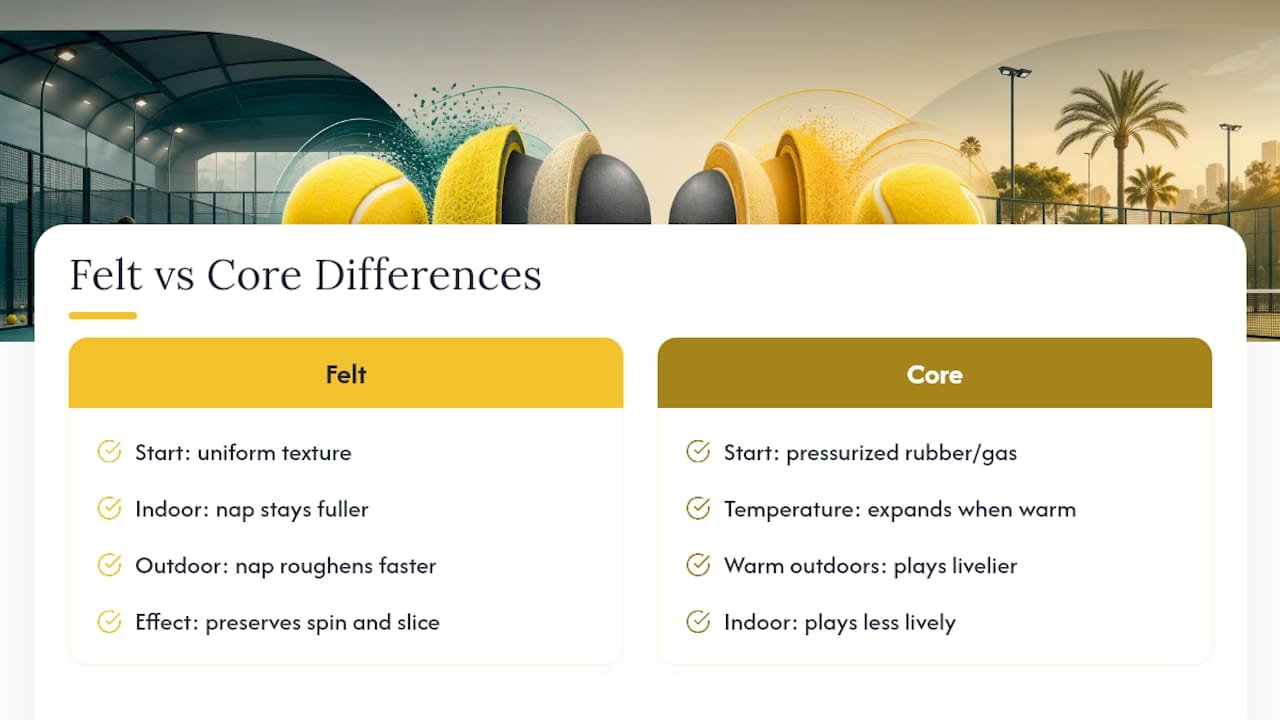
Felt texture starts identical across most padel balls, but indoor play keeps that texture more uniform over time. Without sand or grit grinding against it, the nap stays fuller longer, which preserves spin and slice response. Outdoor play roughens and thins the felt faster, and once that happens, shots that rely on bite off the strings, like a well-cut slice, lose some effectiveness.
Core behavior is where temperature does its work. The rubber and gas inside a pressurized ball respond to heat by expanding, which is why the exact same ball model plays noticeably livelier outdoors on a warm day than it does indoors in a climate-controlled hall. Pressureless balls, with their solid rubber core, are less sensitive to this swing, which is one reason they’re a more forgiving choice for outdoor drilling in variable weather.
None of this means you need a separate ball category for each environment. It means the environment amplifies or dampens the same underlying characteristics, and knowing which direction it’s pushing helps you pick a fast or regular ball intelligently rather than by guesswork. A player who understands this stops blaming their racket for a flat-feeling shot and starts checking the can instead.
A mixed-court player’s take on ball selection
My honest approach after years of watching both indoor leagues and weekend outdoor sessions: keep FIP-approved pressurized cans for anything competitive, and lean hard on pressureless balls for everything else. The cost difference adds up fast if you’re hitting three or four sessions a week, and pressureless balls simply don’t punish your wallet the way opening a fresh match can every practice does.
Padelhip stocks both ends of that setup, from match-ready pressurized cans to pressureless training balls and pressurisers, all backed by an authenticity guarantee and straightforward returns. For budget-conscious players managing volume, that split between premium match cans and durable practice balls is the single highest-value decision you’ll make on equipment this season.
Get match-ready balls and training gear without the guesswork
Once you know the split you need, sourcing it shouldn’t be complicated. Padelhip carries FIP-approved pressurized cans for match day, pressureless balls for high-volume drilling, and pressuriser tubes for players who go through cans fast enough to justify one.
Every order ships with an authenticity guarantee and an easy returns policy, so you’re not gambling on a knockoff can that loses pressure in one session, an increasingly real risk given how much lab testing shows brands vary in bounce retention and endurance. Padelhip’s shipping and authenticity details lay out exactly what to expect before you check out.
If you’re outdoors often, pair your ball order with gear built for the conditions, like the thermal-protected backpack that keeps cans and rackets out of direct heat between matches. Head to the Padelhip store to check current stock on FIP-approved cans and pressureless training packs, and get your mixed-court setup sorted before your next session.
Frequently Asked Questions
Are indoor and outdoor padel balls actually different products?
No. Competition balls all follow the same FIP specifications regardless of court type. The difference you feel comes from temperature, humidity, and surface, not a different ball design.
How long does a pressurized padel ball actually last?
Most pressurized balls hold match-quality bounce for 2 to 4 hours of play before pressure loss becomes noticeable, even sooner in hot outdoor conditions.
Do I need a faster ball for outdoor play?
Not necessarily. Fast balls help on cold or slow courts, indoor or outdoor. On a hot outdoor court that already plays fast, a regular-speed ball is usually the better call.
Can I use pressureless balls in a real match?
You can for casual games, but they lack the lively bounce of pressurized balls and aren’t used in sanctioned competition. Save them for drills, ball machines, and practice.
How do I know when a padel ball needs replacing?
Try the two-lob test: hit two lobs with the same swing. If the second falls noticeably shorter, the ball has lost pressure and it’s time to open a fresh one.
Sources
- Indoor vs Outdoor Padel Equipment | What Actually Changes
- PADEL BALLS APPROVAL 2025 (FIP)
- Padel balls guide — pressurized vs pressureless and high-altitude
- Lab test reveals best padel balls — Testfakta
Recommended
- Padel Shoes vs Tennis Shoes: What Padel Players Need
- Head Padel One Ball Box – Your online Padel store- Padel Hip-Premier padel shop
- Shipping | Authentic Padel Gear Delivered from Spain
- Bullpadel Indiga W 26V Pomelo Women’s Indoor Court Shoes – Flexible Padel Shoes Designed for Comfort, Grip and Quick Movements – Your online Padel store- Padel Hip-Premier padel shop
One thought on “Are Indoor and Outdoor Padel Balls Actually Different?”