

Stop Guessing: 5 Steps to Pick the Right Padel Knee Brace

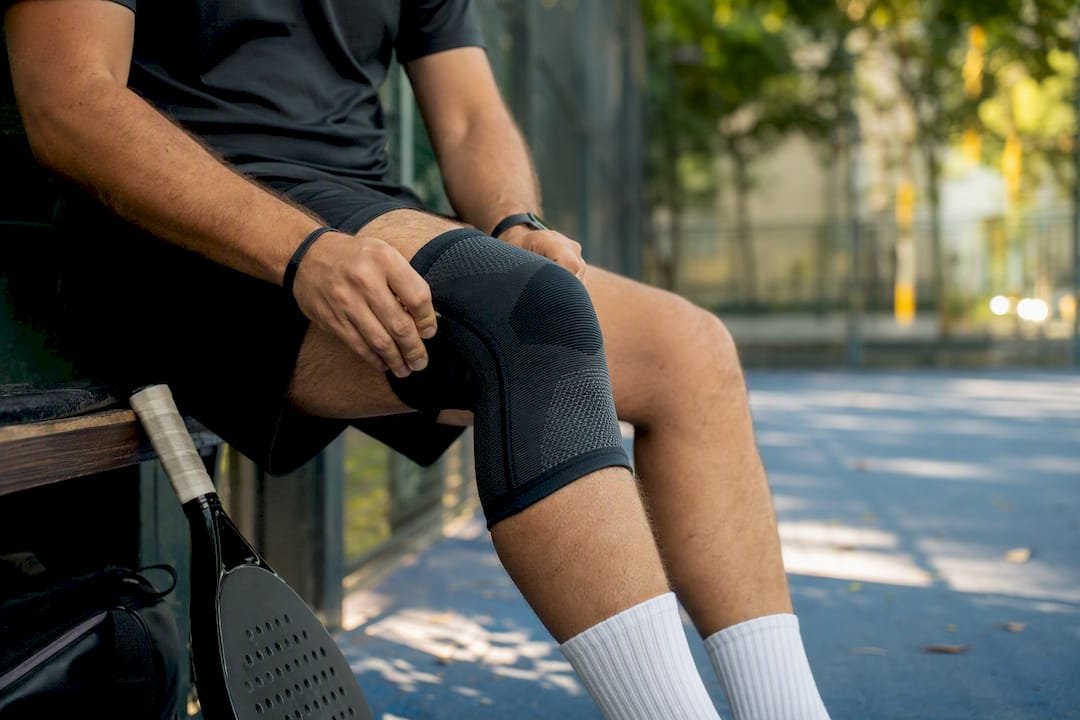
Yes, a knee support helps most padel players, but it works as a supplement, not a fix. Start with a compression sleeve if you feel mild, general soreness after matches. Move up to a patellar strap or hinged brace only if pain is tendon-specific or your knee genuinely feels like it might give way. Either way, the brace does nothing on its own if you skip the strength work behind it.
TL;DR:
- Compression sleeves are suitable for mild soreness but do not prevent ligament instability or lateral knee failure.
- Patellar straps are effective for specific tendon pain below the kneecap but do not support joint stability or wobbly knees.
- Hinged braces provide protection for ligament instability but restrict movement and should be reserved for return-to-play after injury.
- Proper fit and placement are critical, requiring measurement, correct positioning, and testing before play, to avoid slips and ineffective support.
- Strength exercises like hip abductions, single-leg balance, and eccentric quad work are essential to long-term knee stability alongside support use.
Table of Contents
- What Does a Padel Knee Brace Actually Do?
- Which Type of Knee Support Fits Your Padel Injury?
- How to Choose the Right Knee Support for Padel
- How Do You Fit and Wear a Knee Support Correctly?
- Why a Brace Alone Won’t Fix Your Padel Knee
- When I’d Actually Recommend a Padel Knee Brace
- Where to Find Reliable Knee Supports and Padel Gear
- Sources
What Does a Padel Knee Brace Actually Do?
A knee support works through three separate mechanisms, and it helps to know which one you actually need before you buy anything. Compression tightens the tissue around the joint, which raises local blood flow and sharpens proprioception, your knee’s built-in sense of where it is in space and how fast it’s moving. That matters enormously in padel, where you’re constantly lunging, pivoting, and stopping short to return a ball off the back glass.
The second mechanism is purely mechanical. Braces with rigid stays or hinges physically resist excessive sideways movement in the knee, which is the exact motion that tears ligaments during a hard lateral lunge. A compression sleeve can’t do this. It supports tracking and reduces micro-wobble, but it will not stop a real lateral failure the way a hinged brace can.
None of this replaces rehab. The clearest consensus across sports medicine sources is that knee braces function as an adjunct rather than a primary treatment, improving proprioception and compression while mechanically limiting dangerous movement, but never substituting for strength training, load management, or a real recovery plan.
The trade-off you need to accept up front:
- More structural support (hinges, rigid stays) means more protection against lateral failure but less freedom of movement.
- More flexibility and less bulk (compression sleeves) means better agility but weaker resistance if your knee actually buckles.
- No brace improves the underlying strength of your quads, hamstrings, or hip stabilizers. That work happens off the court.
Pro Tip: If you can’t tell whether your knee pain is soreness or instability, ask yourself one question: does the knee ever feel like it’s going to give out, or does it just ache after play? Ache means sleeve. Give-way means see a professional before you buy anything structural.
Which Type of Knee Support Fits Your Padel Injury?
Padel puts unusual strain on the knee compared to running sports. You’re sprinting two steps, stopping dead, then pivoting hard off one leg to hit a smash or a bandeja. That combination of deceleration and rotation is exactly why generic “knee brace” shopping fails so many players. The right support depends entirely on what’s actually hurting.
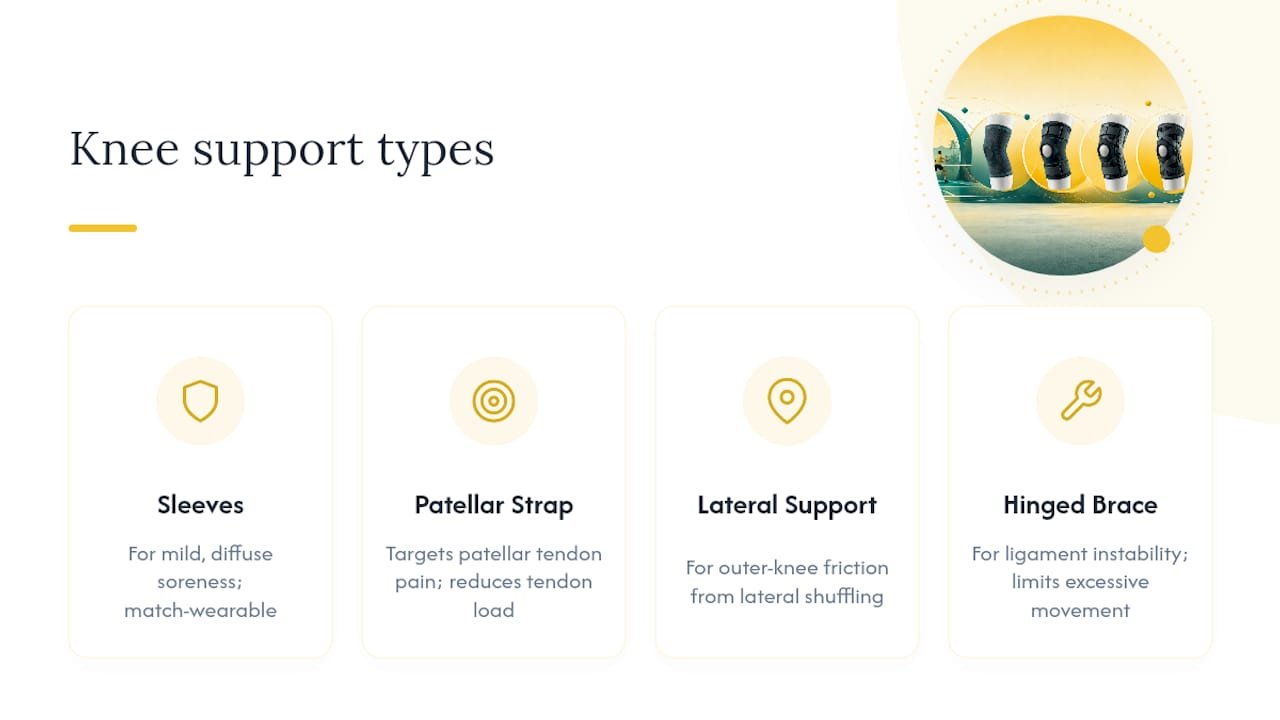
Compression sleeves are the right starting point for most recreational players. They’re built for mild, diffuse soreness, the kind you feel across the whole knee after a long session rather than at one specific point. A sleeve with a patellar cutout offers warmth and proprioceptive feedback with minimal restriction, which is why it’s the only category most players need to wear for a full match without noticing it’s there.
Patellar straps target one specific problem: tendon pain just below the kneecap, commonly called jumper’s knee. Instead of compressing the whole joint, a strap applies focused pressure to the patellar tendon itself. This reduces tendon load in a highly targeted way and is minimally intrusive, but it does nothing for instability, so don’t reach for one if your knee feels loose or wobbly.
IT-band or lateral supports address a different complaint entirely, friction and pain running along the outside of the knee, often triggered by repeated lateral shuffling and quick direction changes on court. These are less common in padel than patellar issues, but if your pain sits on the outer knee rather than under the kneecap, this is the category to look at.
Hinged or structured braces exist for one purpose: real ligament instability, whether from a past injury or a genuine sense that the knee gives way under load. These braces limit excessive movement in damaged or unstable knees and are typically recommended following ligament injuries. The trade-off is agility. A hinged brace adds bulk and restricts range of motion, which is a fair price to pay for real instability but overkill for ordinary soreness.
On usage: sleeves and straps are comfortable enough for full matches and back-to-back practice sessions. Hinged braces are usually reserved for return-to-play situations, worn during matches and structured training but not necessarily left on all day, since prolonged rigid support can encourage the exact over-reliance you’re trying to avoid.
How to Choose the Right Knee Support for Padel
Work through this in order rather than jumping straight to the strongest-looking product on the shelf.
- Locate the pain. Is it under the kneecap, on the outside, or diffuse across the whole joint? Location narrows your options immediately.
- Check for instability. Does the knee ever feel like it’s about to buckle, or does it just ache? Instability changes everything about which category you need.
- Note swelling and timing. Swelling that appears during or right after play, versus soreness that shows up the next morning, points to different underlying issues and different urgency levels.
- Match the symptom to the support. Diffuse soreness gets a sleeve. Localized tendon pain under the kneecap gets a strap. Outer knee friction gets a lateral support. Any sense of giving way gets a hinged brace, and a conversation with a professional.
- Consider the court. Padel demands quick lateral cuts on a hard surface, so weight, breathability, and grip against your shorts or leggings matter more than they would in a gym setting.
A few practical filters help once you’ve narrowed the category:
- Look for moisture-wicking fabric. Sweat-soaked compression loses its grip and starts sliding mid-match.
- Check for a non-slip silicone band at the top edge. Sleeves without one migrate downward within a set.
- Weigh the bulk against your position. Net players pivoting constantly notice extra material more than baseline players.
See a physio or a GP if: pain persists beyond two weeks despite rest, swelling appears without a clear cause, the knee locks or catches, or you feel any instability at all. A brace bought online is not a diagnosis.
How Do You Fit and Wear a Knee Support Correctly?
A support that fits poorly can do more harm than wearing nothing, mostly by giving you false confidence in a joint that’s still compromised. Getting the fit right takes five minutes and prevents most of the common complaints.
- Measure before you buy. Wrap a soft tape measure around the knee at the midpoint of the kneecap, then again roughly 6 inches below it. Most sizing charts use both measurements, and skipping this step is the single most common fitting mistake.
- Put it on before you’re warmed up, not after. Sleeves and straps go on easiest when muscles aren’t yet swollen from activity.
- Position the patellar cutout precisely. The opening should sit directly over the kneecap, not above or below it. A few millimeters off and you lose the tracking benefit entirely.
- Test lateral movement before you play. Do a few side shuffles and a lunge in the changing room. If the sleeve rolls or the strap slides, tighten it or size down.
- Decide on match-time removal. Compression sleeves and straps generally stay on for the full session. Hinged braces sometimes come off between sets if they’re causing excess heat or restriction, but check with whoever prescribed it first.
Pro Tip: Skip long socks or leggings that bunch under a sleeve. That extra layer is the number one cause of slippage mid-rally, and it’s an easy fix most players never think about.
Inspect straps and sleeves every few weeks. Stretched-out elastic, a silicone band that’s stopped gripping, or a strap that no longer holds tension all mean it’s time to replace the piece rather than keep tightening it further.
Why a Brace Alone Won’t Fix Your Padel Knee
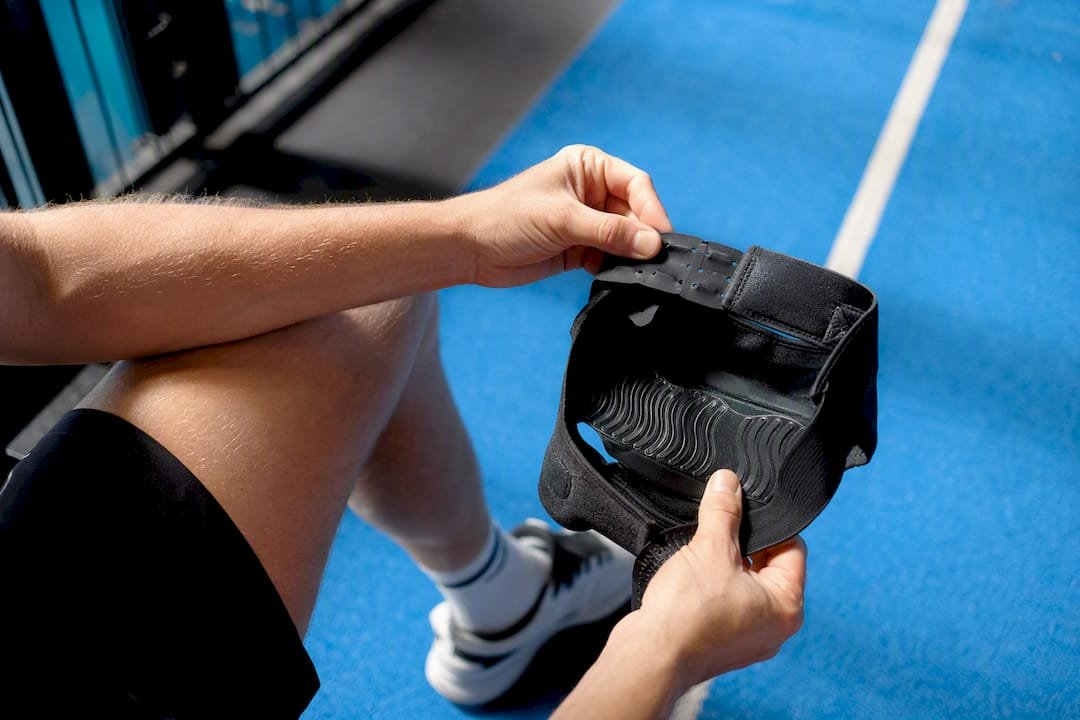
The brace is never the whole plan. Clinicians consistently warn that heavy structural support worn without parallel conditioning work can actually weaken the muscles that stabilize the knee over time, leaving you more dependent on the brace rather than less. That’s the trap: the more the brace does the work, the less your own stabilizers have to.
Three exercises cover most of what padel demands from the knee, and none require a gym membership:
- Hip abduction: side-lying leg lifts or band walks, 2 to 3 sets of 12 to 15 reps, strengthen the glute medius that controls lateral knee drift.
- Single-leg balance with perturbations: stand on one leg for 30 seconds while a partner gently pushes you off balance, rebuilding the reflexive stability that protects against sudden direction changes.
- Eccentric quad work: slow, controlled step-downs off a low box, 3 sets of 10 per leg, target the exact loading pattern that causes patellar tendon pain in the first place.
Weekend players who go from a desk chair straight into two hours of aggressive lateral movement carry the highest injury risk in the sport. If your week has zero conditioning work in it, a brace is compensating for a gap that will eventually catch up with you. Structured programs on load management and injury prevention habits for lateral-movement athletes are worth building into a weekly routine, not just pulling out after pain shows up.
Track progress by testing whether symptoms hold steady, worsen, or fade as you add strength work. If pain drops off over four to six weeks, that’s your signal to start reducing reliance on the support rather than wearing it indefinitely.
When I’d Actually Recommend a Padel Knee Brace
A weekend player with generic post-match soreness gets a sleeve, full stop. Recurrent, localized pain under the kneecap gets a strap and a look at their eccentric quad work. Genuine giving-way gets a referral to a clinician before any brace decision, because a hinged brace without a diagnosis is guesswork wearing a bandage.
Pair whatever you choose with two strength sessions a week, and give it four to six weeks before judging whether it’s helping. Anything faster than that is wishful thinking.
— Serena
Where to Find Reliable Knee Supports and Padel Gear
Padelhip stocks the categories covered above, compression sleeves, patellar straps, and supportive accessories, alongside the footwear and apparel that actually affect how your knee loads on court in the first place. Every product ships as genuine, authentic gear, backed by fast delivery and a straightforward returns process, so a poor fit or a change of mind doesn’t leave you stuck with unused equipment.

Footwear matters more than most players realize when it comes to knee load. The right sole pattern reduces the twisting force your knee absorbs on quick pivots, which is exactly why pairing a support with proper court shoes built for lateral stability does more for your knees than the brace alone. Browse the full range at the Padelhip store and build a setup that protects your knees from the ground up, not just at the joint.
One thought on “Stop Guessing: 5 Steps to Pick the Right Padel Knee Brace”