

Padel Grip Size: How to Measure and Choose the Right Fit

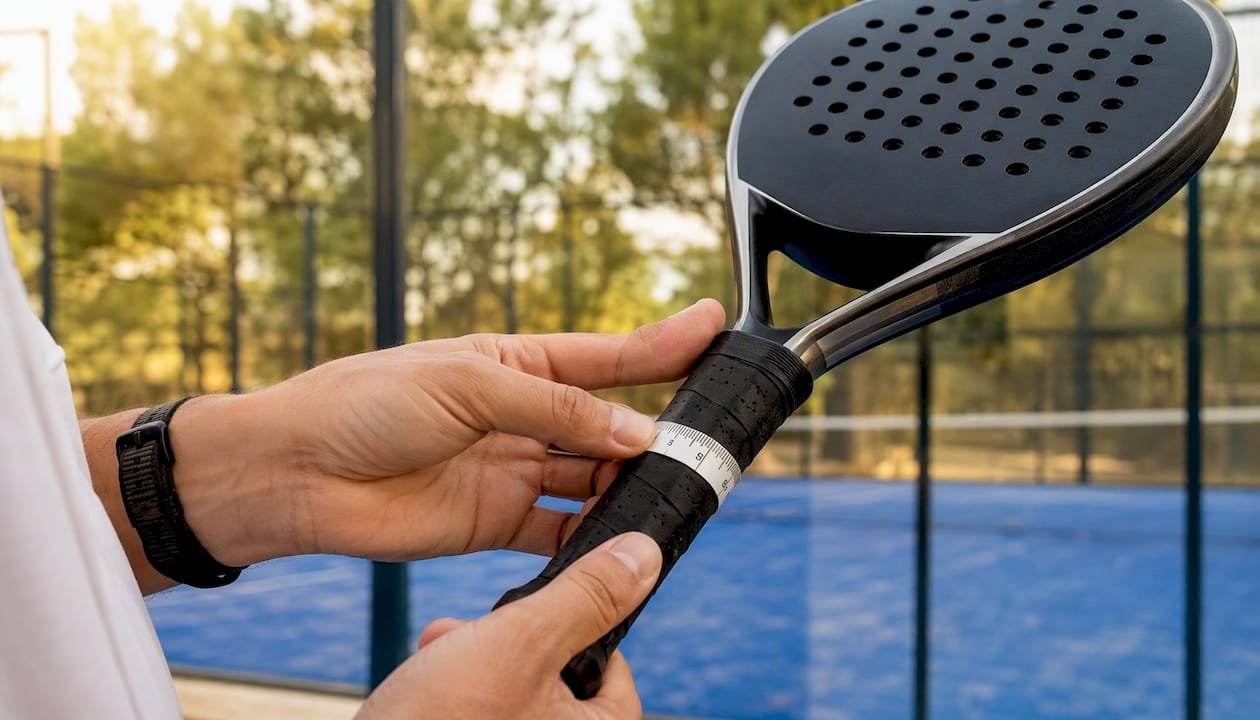
Most adult men play best with an L3 grip (4 3/8" / 111 mm circumference), and most adult women with an L2 (4 1/4" / 108 mm). Those are your starting defaults if you need a number right now. But the fastest way to confirm your size is a two-second test: hold the racket in a continental grip (the handshake hold) and check the gap between your fingertips and the base of your palm. One finger fits? You’re sized correctly. No gap at all means go up. Two fingers of space means go down.
If the grip runs small, the fix is simple:
- Add one overgrip. Each one adds roughly 1/16" to the circumference.
- Two overgrips bring you up approximately one full size.
- If the grip is too large, a replacement base grip or heat-shrink sleeve is the right move — you can’t easily shave thickness off an existing handle.
When in doubt, go smaller and add an overgrip. Adding thickness is easy. Removing it isn’t.
Key Takeaways
The single most important rule in padel grip sizing: when you’re unsure between two sizes, choose the smaller one and build up with an overgrip rather than starting too large and having no way to reduce thickness.
| Point | Details |
|---|---|
| Default size starting points | L3 suits most adult men; L2 suits most adult women — use these as your baseline before measuring. |
| Fastest sizing test | Use the finger-gap test in a continental grip: one finger between fingertips and palm means correct size. |
| Overgrip increment rule | Each overgrip adds ~1/16"; two overgrips equal roughly one full L-size increase. |
| When to replace vs. add | Replace the base grip when it’s worn or the size gap exceeds two overgrip layers; use heat-shrink for a permanent half-size bump. |
| Padelhip for grips and gear | Padelhip stocks overgrips, replacement grips, and full racket packs with circumference specs listed to help you buy the right size online. |
Table of Contents
- Why padel grip size affects comfort, control, and injury risk
- Standard padel grip sizes: L0 through L5
- How to measure your hand for the right grip size
- How to change grip thickness without replacing the whole handle
- When to use an overgrip and when to replace the base grip
- Which grip size suits juniors, women, men, and spin-focused players
- How to tell if your grip is wrong and what to fix
- Step-by-step: how to apply an overgrip or replace a base grip
- What Padelhip stocks and how it helps you get the right fit
- Get the right grip from Padelhip
- Sources
Why padel grip size affects comfort, control, and injury risk
The grip is the only contact point between you and the racket. Get it wrong and everything downstream suffers — touch, wrist snap, and over time, your elbow.
A grip that’s too small lets the wrist move freely, which helps generate spin. The downside: your fingers can dig into your palm under pressure, and the extra wrist movement creates inconsistency on volleys. Over a long session, that micro-tension builds into real fatigue.
A grip that’s too large does the opposite. It locks the wrist, which kills topspin and reduces your ability to redirect the ball quickly. Players with oversized grips often compensate by squeezing harder, which shifts strain to the forearm and elbow. That’s a short path to chronic discomfort.
Grip pressure matters here too. The continental grip at a relaxed 5–6 out of 10 pressure is the standard for padel. At that pressure, a correctly sized grip should feel secure without any clenching. If you’re squeezing to keep control, the grip is probably too large.
Pro Tip: When you’re between two sizes, always choose the smaller one. You can build up thickness easily with an overgrip. You cannot easily reduce a grip that’s already too thick.
Standard padel grip sizes: L0 through L5
Padel rackets use an L-scale, typically running from L0 (smallest) to L5 (largest). The table below maps each size to its circumference in both inches and millimeters, with a quick note on who each size typically suits.
One important caveat: padel grip labels are not fully standardized across brands. An L2 from one manufacturer can differ by several millimeters from another brand’s L2. That’s why measuring circumference directly is more reliable than trusting the label alone. A comfortable adult grip typically falls within a moderate circumference range that is suitable for most adults.
Pro Tip: When buying online, check the manufacturer’s spec sheet for the actual circumference measurement rather than relying on the L-size label. A few millimeters of difference can change how the racket feels in your hand.
How to measure your hand for the right grip size
Two methods work well, and you can do both in under a minute.
Method 1: Palm-to-ring-finger measurement
- Hold your dominant hand open, fingers together and straight.
- Using a ruler or soft measuring tape, measure from the middle crease of your palm (the horizontal line across the center) to the tip of your ring finger.
- Match that measurement to the size table: 4 3/8" (111 mm) puts you at L3, for example.
- If you land between sizes, round down and plan to add an overgrip.
Method 2: The finger-gap test (quickest check)
- Pick up a racket and hold it in a continental grip — as if you’re shaking hands with the handle.
- Wrap your fingers around the grip naturally.
- Check the gap between your fingertips and the base of your palm (the fleshy pad below your thumb).
- One finger fits comfortably in that gap: correct size. No gap: too small. Two fingers: too large.
A few extra tips:
- Measure your hand after a warm-up, not cold — hands swell slightly during play.
- If you already own a racket that feels right, measure its circumference with a soft tape and use that number as your benchmark when shopping.
- Repeat the finger-gap test on any new racket before buying if you can handle it in person.
How to change grip thickness without replacing the whole handle
You don’t need a new racket every time the grip feels off. Three practical methods let you adjust thickness at home.
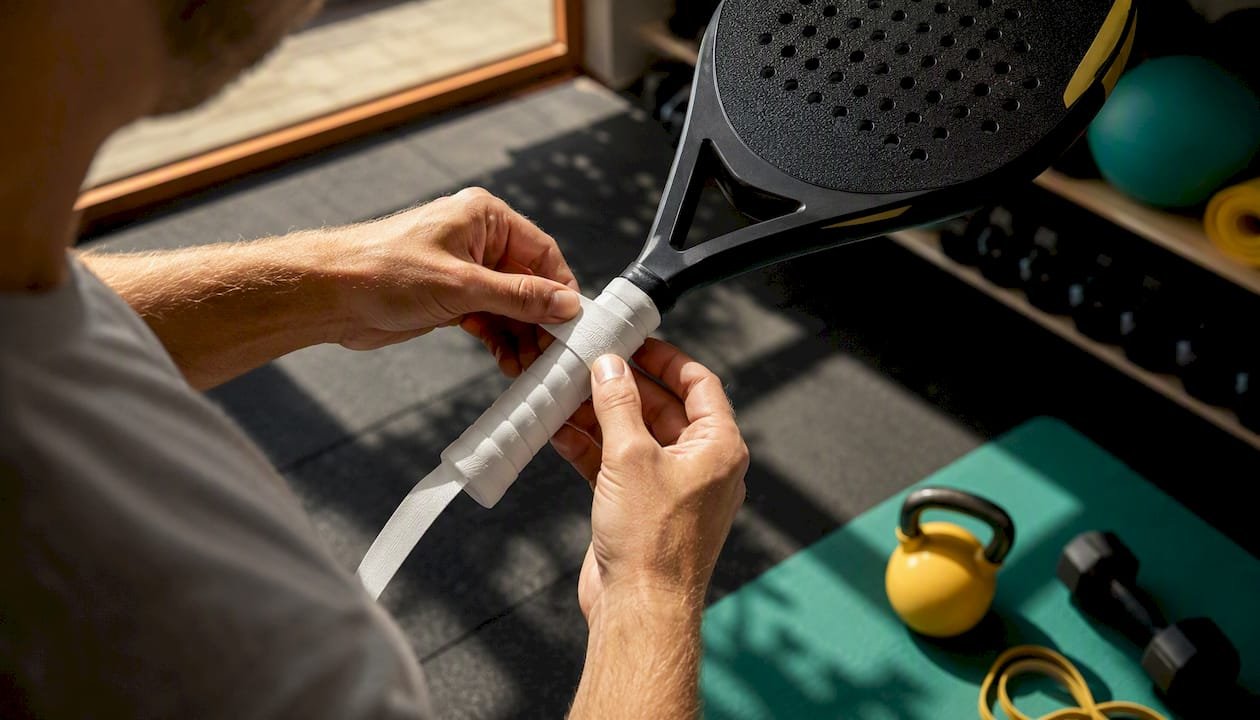
Overgrips
The most common fix. Each overgrip adds approximately 1/16" to the circumference, and two overgrips together bring you up roughly one full size. They’re inexpensive, reversible, and take about three minutes to apply. The trade-off: stacking multiple overgrips reduces tactile feedback. Beyond two layers, most players notice a deadening of feel.
Heat-shrink sleeves
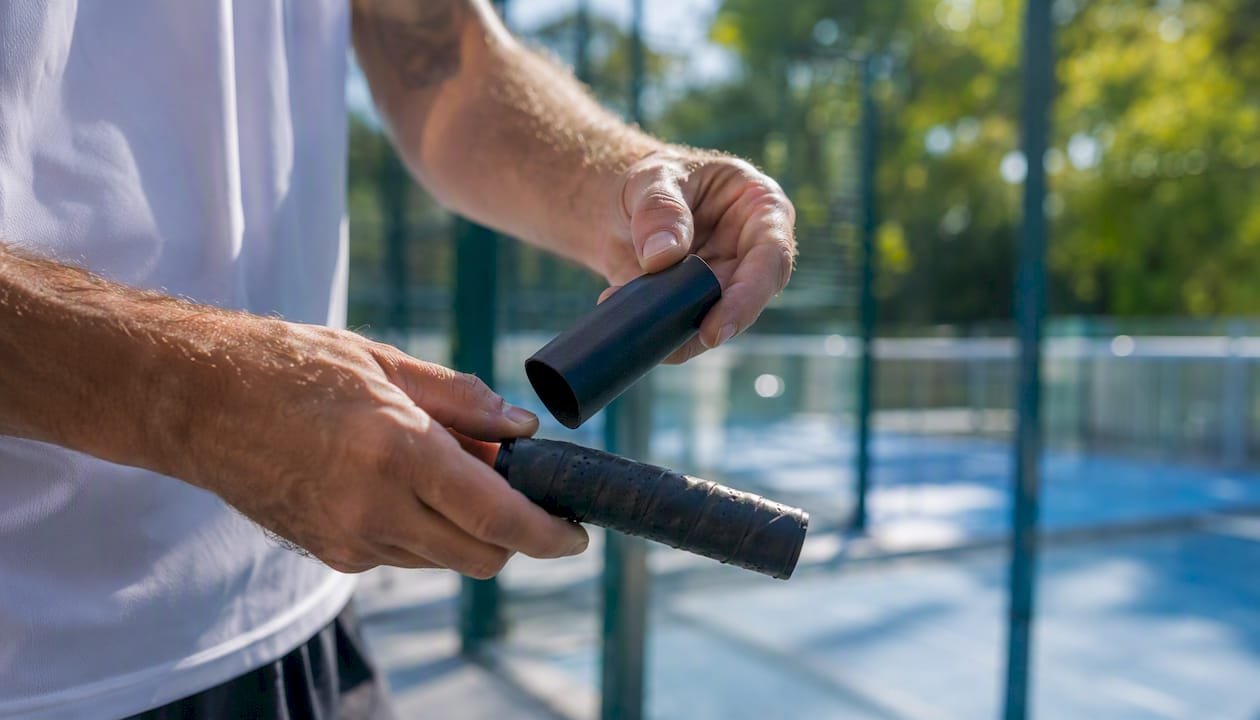
A heat-shrink sleeve slips over the existing handle and, once heated, bonds permanently. It typically adds around 1/8" — roughly the equivalent of two overgrips — in a single, clean layer. The result is more durable than stacked overgrips and feels more like a factory grip. The downside is permanence: once shrunk, it’s difficult to remove without damaging the handle.
Replacement base grips
When the base grip itself is worn, damaged, or the wrong thickness entirely, a replacement grip is the right call. These are thicker than overgrips and replace the underlying layer rather than adding to it. They’re the best option when you’re starting from a stripped handle or when the existing base is so compressed it no longer provides any cushion.
Size rule of thumb: Each overgrip ≈ 1/16". Two overgrips ≈ one full L-size increase. A heat-shrink sleeve ≈ 1/8" (two overgrips in one layer).
Pro Tip: If you’re adding more than two overgrips to make a grip feel right, the base grip is probably the wrong size. At that point, a replacement base grip or a different racket handle is a better long-term fix.
When to use an overgrip and when to replace the base grip
The short answer: overgrips for minor tweaks and sweat management; replacement grips when the base itself is the problem.
Choose an overgrip when:
- The grip is close to the right size but slightly too thin.
- You want better tack or sweat absorption without changing the underlying handle.
- You need a reversible, low-cost adjustment.
- You’re adding one or two layers maximum.
Choose a replacement base grip when:
- The existing base is worn flat, cracked, or compressed.
- You need to reduce thickness (remove old layers, then replace with a thinner base).
- You’re starting from a bare handle after stripping everything off.
- The size difference is more than one full L-size — overgrips alone won’t bridge that gap cleanly.
Consider a heat-shrink sleeve when:
- You want a permanent half-size increase without the bulk of multiple overgrip layers.
- You prefer the feel of a single clean layer over stacked wraps.
For a deeper look at the trade-offs, the overgrip vs. replacement grip breakdown covers application steps and durability comparisons in full.
Which grip size suits juniors, women, men, and spin-focused players
Start here if you want a size before you’ve measured anything.
Juniors:
- Ages 6–9: L0 (4" / 102 mm) — small hands need a small handle to maintain control.
- Ages 10–13: L1 (4 1/8" / 105 mm) — a step up as hands grow, still manageable for shorter fingers.
- Consider a junior racket with a factory L0 or L1 grip rather than wrapping down an adult handle.
Adult women:
- Most recreational female players land at L2 (4 1/4" / 108 mm).
- Smaller hands or players who prioritize wrist freedom for spin often prefer L1.
Adult men:
- L3 (4 3/8" / 111 mm) is the most common size for average-handed adult men.
- Players with larger hands or those who prefer a locked, stable grip may find L4 more comfortable.
Advanced players who want more spin:
Many experienced players deliberately choose one size smaller than their measured size. A slightly smaller grip lets the wrist rotate more freely through contact, which translates directly to more topspin and faster racket-head speed. They then add a single overgrip for tack and sweat control without fully closing that wrist freedom.
How to tell if your grip is wrong and what to fix
Signs your grip is too small
- Fingers press into your palm during hard shots.
- Blisters develop on the inside of your fingers after a session.
- The racket twists in your hand on off-center hits.
- Your volleys feel inconsistent even when your timing is right.
Quick fixes:
- Add one overgrip and retest the finger-gap.
- If the problem persists, add a second overgrip or switch to a replacement base grip one size up.
Signs your grip is too large
- Your wrist feels locked; generating topspin takes extra effort.
- Forearm or elbow fatigue appears earlier than usual.
- You find yourself squeezing the handle to maintain control.
Quick fixes:
- Strip the overgrips down to the base grip and retest.
- If the base grip itself is too thick, replace it with a thinner one or try a racket with a smaller handle.
- Test with a known-good racket from a friend or a demo to confirm the diagnosis before spending money.
Step-by-step: how to apply an overgrip or replace a base grip
Removing an old overgrip
- Find the finishing tape at the top of the handle and peel it back.
- Unwind the overgrip slowly from top to bottom — it usually comes off in one piece.
- Wipe the base grip clean with a dry cloth.
Applying a new overgrip
- Start at the base of the handle (butt cap end), angling the grip at roughly 45 degrees.
- Wrap upward with a consistent 1/4" overlap on each pass.
- Pull the grip slightly taut as you wrap — not tight enough to stretch it thin, just enough to eliminate air gaps.
- Secure the top end with the finishing tape included in the pack.
Installing a replacement base grip
- Remove the old base grip completely, including any adhesive residue.
- Peel the backing from the new grip and start at the butt cap, same 45-degree angle.
- Wrap with firm, even tension and smooth out any bubbles as you go.
- Secure with finishing tape and trim any excess at the top.
Installing a heat-shrink sleeve
- Slide the sleeve over the bare handle before applying any grip.
- Apply heat evenly with a heat gun (not a lighter) in short passes — 3–5 seconds per section.
- Let it cool fully before wrapping an overgrip on top.
What Padelhip stocks and how it helps you get the right fit
Padelhip carries overgrips, replacement base grips, and full racket packs that include grip accessories — so whether you’re fine-tuning an existing handle or starting fresh, the right product is available without hunting across multiple stores.
A few practical pointers based on common player needs:
- Overgrips solve the most common problem: a grip that’s slightly too thin or too slick. They’re the first thing to try.
- Replacement grips are the right call when the base is worn or the size gap is more than one overgrip layer.
- Full racket packs (like the Bullpadel Vertex 04 Woman 2025 Pack) often include accessories and are worth considering when you’re replacing a racket and want to start with the right setup from day one.
Pro Tip: Match grip texture to your playing style. Tacky grips give more control and suit players who rely on touch and placement. Thinner, drier grips suit players who want maximum wrist freedom for spin-heavy shots.
Because grip labels vary by brand, Padelhip’s product descriptions include circumference specs where available — worth checking before you order.
A note from Serena
Helping players pick the right grip is one of those things that looks simple until you’re standing in front of a rack of rackets with no tape measure. The most common mistake is going too large — it feels more secure in the shop, but that false security costs you spin and wrist snap on the court. The second most common mistake is stacking three or four overgrips to compensate for a handle that was never the right size to begin with. Measure first, adjust second. If you’re unsure, Padelhip’s team can point you toward the right grip type and size for your hand and playing style.
Get the right grip from Padelhip
Padelhip stocks a full range of padel grips, overgrips, and replacement grip accessories, with fast shipping and easy returns if the size isn’t right. Whether you need a single overgrip to fine-tune your current racket or a complete padel racket setup matched to your hand size, everything ships quickly and comes backed by genuine product knowledge.

Check the Bullpadel Vertex Advance 26 if you’re also in the market for a new racket — it’s a strong intermediate-to-advanced option available with standard grip sizing. For grip accessories and sizing questions, head to Padelhip and the team can help you find the right fit before you buy.
Sources
- Padel Grip Guide: Continental Grip, Overgrip & How to Hold a Padel Racket | Padel Coach Finder
- Padel grip size: how to find the right fit (and why it matters for your elbow) — Padel Underground
- Swing Grip Size Guide
- Padel Grip: How to Hold a Padel Racket (The Complete Guide) | RacketRise
Recommended
- Overgrip vs Replacement Grip: What Padel Players Need to Know
- Choosing the Right Padel Racket Shape: A Complete Guide – Your online Padel store- Padel Hip-Premier padel shop
- Padel Shoes vs Tennis Shoes: What Padel Players Need
- Bullpadel Vertex Vibram 25I Padel Shoes – Pro Stability & Grip – Your online Padel store- Padel Hip-Premier padel shop