

Padel Sweet Spot: Where to Hit for Power and Control

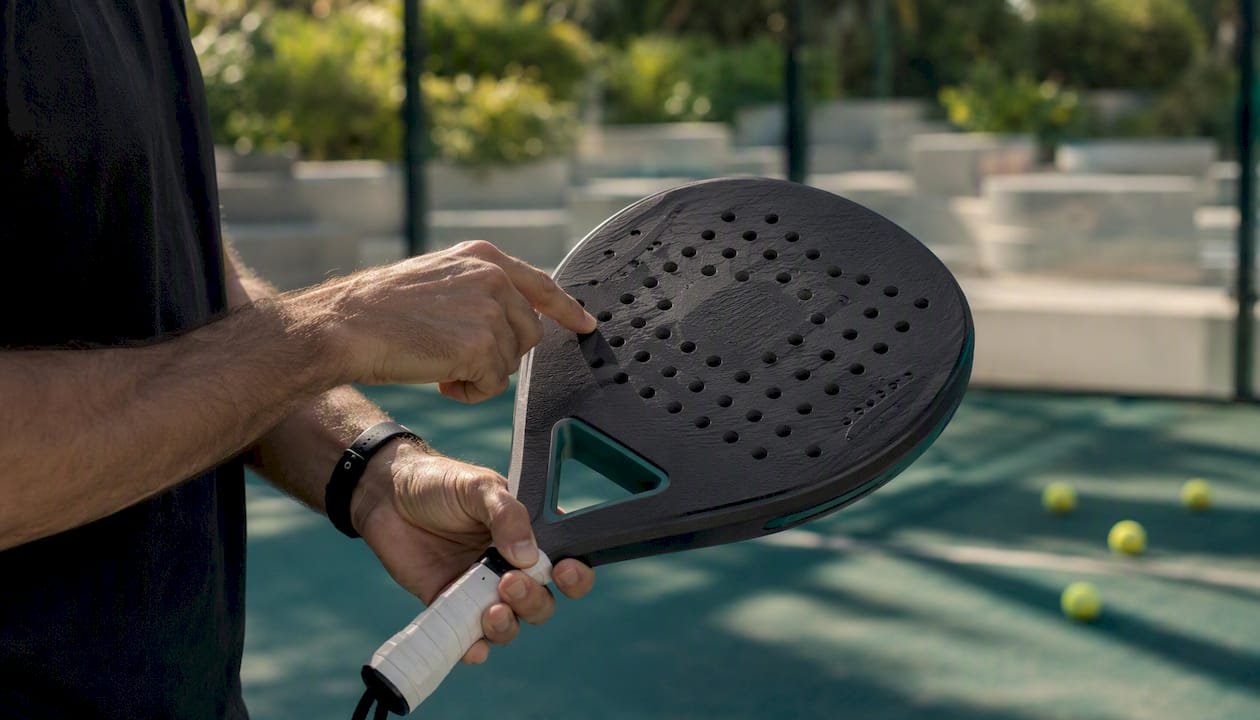
The padel sweet spot sits roughly in the upper-middle third of the racket face, measured from the top of the racket head. That single number comes from a peer-reviewed study of 225 padel rackets tested with a robot and accelerometers, and the range across those rackets ran from 118 mm to 147 mm. Before you read another word, grab your racket and tap your knuckle slowly from the tip down toward the throat. The spot where the sound shifts from a dull thud to a clean, resonant “ping” is your sweet spot. That’s the padel impact area you want to find every single time you swing.
Why does it matter so much? Hitting the sweet spot transfers maximum energy into the ball while sending minimum vibration back through the handle to your wrist and elbow. Miss it by even a centimeter toward the frame, and you feel the sting. Miss it toward the throat, and the ball goes nowhere. Consistent contact in that zone is the difference between a controlled, deep drive and a weak, off-line shot that your opponent reads before it crosses the net.
Key Takeaways
The most reliable way to improve your padel game is to locate your racket’s sweet spot, train contact there deliberately, and choose gear that matches your current skill level.
| Point | Details |
|---|---|
| Average SSP position | The sweet spot sits at an average of 134 mm from the top, with a typical range of 118–147 mm across rackets. |
| Shape doesn’t guarantee SSP | Lab data shows no clear correlation between racket shape, weight, or balance and actual sweet-spot position. |
| DIY knuckle tap test | Tap along the central axis and find the spot with the cleanest sound and least vibration — that’s your SSP. |
| Train with progressive drills | Start with slow-feed contact drilling, then add movement, then fatigue-pressure reps. |
| Padelhip for gear and guidance | Padelhip stocks authentic rackets at every skill level with clear return policies and expert buying guidance. |
Table of Contents
- What exactly is the sweet spot on a padel racket?
- Where does the sweet spot actually sit on your racket?
- Does racket shape, weight, or balance determine sweet-spot position?
- Three simple at-home tests to find your racket’s sweet spot
- Progressive drills to hit the sweet spot consistently
- Buying checklist: how to choose a racket if you want an easy-to-hit sweet spot
- How labs actually measure the sweet spot
- The part most players get wrong about sweet-spot training
- Ready to find your next racket at Padelhip?
- Sources
What exactly is the sweet spot on a padel racket?
The sweet spot is the impact area on the racket face that maximizes energy transfer to the ball while minimizing the vibration transmitted back to your hand. In lab terms, researchers define it as the position of minimum vibration severity at the handle — the point where the racket “absorbs” the impact most efficiently rather than bouncing it back at your wrist.
Players experience it through three clear cues:
- Sound: A clean, solid “pop” rather than a hollow or metallic clatter
- Feel: Little to no sting or buzz in the grip hand
- Ball flight: A flatter, more predictable trajectory with noticeably more pace
The contrast when you miss it is just as obvious. Hit toward the tip or the frame edge and you get a sharp vibration spike up the handle. Hit too close to the throat and the ball dies, dropping short with no depth. Neither outcome is subtle.
The technical term used in measurement research is the Sweet Spot Position (SSP) — specifically the location of minimum vibration parameter V along the racket’s central axis. That’s distinct from the geometric center of the face, which is where many players assume the sweet spot lives. On most padel rackets, the SSP sits noticeably higher than the geometric center, which is why players who aim for the middle of the face often wonder why their shots feel inconsistent.
Where does the sweet spot actually sit on your racket?
The 225-racket study measured SSP from the top of the racket head along the central axis. Here’s what the data showed:
The spread in sweet spot position among rackets can be significant, meaning two similar rackets may differ noticeably in where their sweet spots fall. Some rackets show a narrow, precise zone that rewards clean technique. Others have a wider, more forgiving zone that tolerates slight off-center contact. You cannot tell which type you’re holding just by looking at it.
The reference point matters too. Measurements run from the top of the racket head, not from the handle or the throat. So 134 mm down from the tip puts the average SSP well above the geometric midpoint of a standard padel face, which typically spans around 260–280 mm in length. That upper-third position is consistent with why diamond-shaped rackets feel like they reward tip contact — the SSP on those frames often sits even higher.
Does racket shape, weight, or balance determine sweet-spot position?
Here’s where conventional wisdom runs into a wall. The same study that produced the 134 mm average also tested whether SSP correlated with racket shape, mass, balance point, or moment of inertia. The result: no clear correlation with any of those variables.
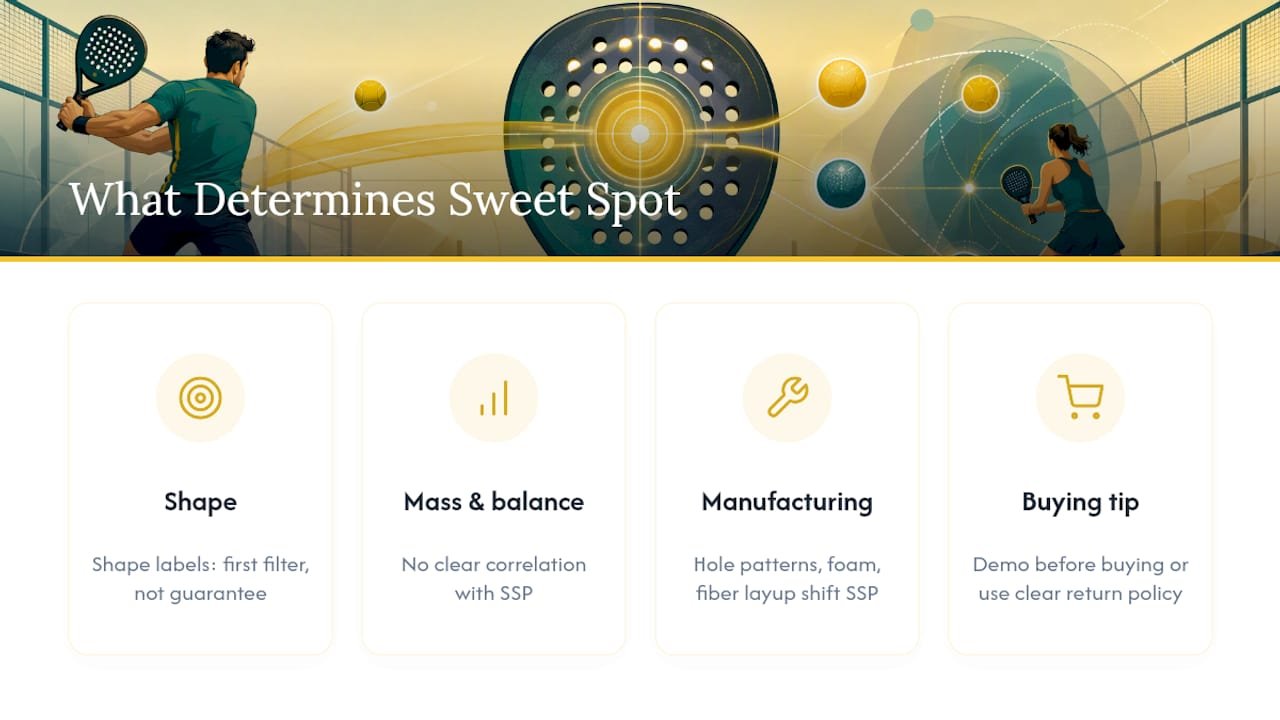
That finding cuts against a lot of popular buying advice. The common story goes like this: diamond shapes push the sweet spot toward the tip for more power; round shapes center it for more forgiveness; teardrop splits the difference. Expert guides do describe those tendencies, and they’re useful as broad starting points. But the lab data says shape alone doesn’t reliably predict where your specific racket’s SSP lands.
Why the disconnect? Manufacturing variability. Hole patterns, foam density, fiber layup, and even manual assembly tolerances all shift the vibration profile of a finished racket in ways that shape alone can’t predict. Two diamond rackets from the same manufacturer can have meaningfully different SSP positions.
The practical buying implication: Shape labels are a reasonable first filter, not a guarantee. Round rackets tend to suit beginners because their SSP is typically more centered and the zone is wider, while diamond frames favor advanced players who want power from a higher contact point. But the only way to confirm where a specific racket’s sweet spot sits — and how forgiving it is — is to test it yourself. Demoing before buying, or using a clear return policy, matters more than trusting the shape label alone. Padelhip’s racket shape guide walks through how balance and materials interact with feel, which is a useful companion read when you’re narrowing down options.
Three simple at-home tests to find your racket’s sweet spot
You don’t need a robot or accelerometers. These three methods work with gear you already have.
1. The knuckle tap test
Hold the racket loosely by the handle so it can vibrate freely. With the knuckle of your index finger, tap firmly along the central axis of the face, starting at the tip and moving down in roughly 1 cm increments. Listen and feel. The spot where the sound is clearest and fullest — and where the vibration in your holding hand is lowest — is your SSP. Mark it lightly with a small piece of tape. Repeat the sequence three times and confirm the same spot each time.
2. The impact print test
Apply a thin layer of chalk dust, foot powder, or impact tape to the face of your racket. Hit 20 balls against a wall or have a partner feed you slow, consistent shots. After 20 impacts, check where the marks cluster. The densest cluster shows your natural contact tendency. If it’s above or below the 118–147 mm zone from the tip, your swing path or contact timing needs adjustment.
3. The vibration hand test
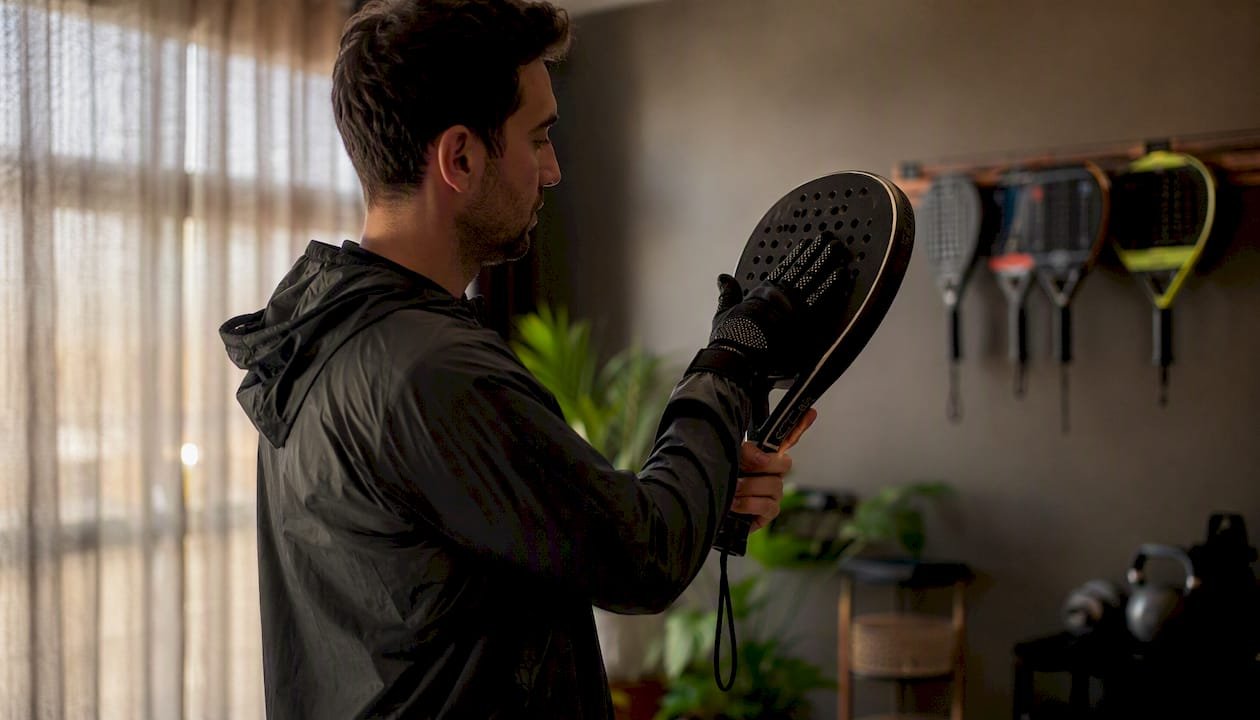
Wear a thin glove on your racket hand and hit a series of balls at different points on the face, consciously moving from tip to throat. The point where you feel the least buzz through the glove is your SSP. If you have a smartphone accelerometer app (several free options exist for iOS and Android), you can hold the phone against the handle during impact and compare readings across positions — the minimum reading corresponds to the SSP.
Safety note: Run these tests with the racket cover off and away from walls or other players. For the impact print test, use a protective sleeve or tape over the frame edge to avoid chipping the carbon or fiberglass. Never strike the frame edge directly.
Pro Tip: Collect at least 20 impacts per test point and average your observations. A single tap can mislead you; a pattern across 20 contacts tells you something real.
Progressive drills to hit the sweet spot consistently
Knowing where your SSP is means nothing if you can’t reproduce contact there under pressure. These three drills build that skill progressively.
Drill 1: Slow-feed contact zone drilling (beginner)
Have a partner feed you slow, waist-high balls from the same spot, or use a ball machine set to low speed. Your only goal is to make contact at the marked SSP on every shot. Start with forehand drives, then switch to backhands. Hit 50 reps per session and count how many produce the clean “pop” sound and low vibration.
Coaching cues to watch: keep the wrist firm at impact, not flicking; position the contact point slightly in front of your body, not beside your hip; keep the racket face square rather than open or closed at the moment of contact.
Drill 2: Movement plus contact (intermediate)
Add lateral movement before each shot. Your partner feeds balls to alternating sides so you have to recover, set your feet, and then make contact. The challenge is reproducing the same SSP contact you found in Drill 1 while moving. Track your clean-contact percentage across 50 reps.
For progress tracking, reactive strength and contact-consistency metrics used in athletic training translate directly here: measure your hit percentage over 50 or 100 reps and log it weekly.
Drill 3: Small-target pressure drill (advanced)
Place a small cone or target on the opposite side of the court. Your goal is to hit the target while maintaining SSP contact under fatigue. Run this drill in the last 10 minutes of a practice session when your arms are tired. Fatigue exposes technique breakdowns faster than any other condition. Track both target accuracy and perceived vibration score (rate each shot 1–5 for hand buzz) across 30 reps.
- Wrist stiffness check: a floppy wrist at impact shifts contact toward the tip or frame edge
- Contact point depth: too late (beside the hip) pushes contact toward the throat
- Racket face angle: even a 10-degree open face at impact moves the effective contact zone off the SSP
Buying checklist: how to choose a racket if you want an easy-to-hit sweet spot
Not every racket suits every player’s contact tendencies. Use this checklist before you buy.
- Prioritize round or low-balance frames if you want forgiveness. Round heads tend to place the SSP closer to center with a wider zone. Beginner-friendly rackets are almost always built around this principle. If you’re still developing your swing, a round frame is the lower-risk choice.
- Demo before you commit. Shape labels are a starting point, not a guarantee. The lab data is clear: SSP doesn’t reliably follow shape. Hitting 20–30 balls with a racket tells you more than any spec sheet.
- Check the return policy. If you’re buying online and can’t demo first, a clear return window is your safety net. Know the policy before you click “buy.”
- Fiberglass vs. carbon: Fiberglass faces generally produce a softer, more forgiving feel with a slightly wider perceived sweet zone. Carbon frames are stiffer, which concentrates power but narrows the margin for error. Beginners and intermediate players often find fiberglass more forgiving; advanced players typically prefer carbon’s precision. The HEAD Vibe 2026 is a good example of a fiberglass frame marketed specifically for its large sweet spot.
- Match the racket to your skill level. A diamond-shaped power frame with a high SSP rewards clean, aggressive technique. If your contact point is still inconsistent, that racket will punish you on every off-center hit.
- Ask customer service. If a product page doesn’t specify SSP characteristics, ask. A good retailer can tell you whether a racket skews toward forgiveness or precision based on player feedback.
- Budget and materials together. A higher price doesn’t always mean a larger sweet spot. Check padel racket prices by budget tier to understand what you’re actually paying for at each level.
How labs actually measure the sweet spot
The 225-racket study used a robot arm to strike each racket at multiple points along its central axis under controlled, repeatable conditions. An accelerometer mounted at the handle recorded the vibration signal after each impact. From that signal, researchers computed a parameter called V, which quantifies the severity of the shaking felt at the wrist after contact.
The SSP is simply the impact position where V reaches its minimum value — the spot that produces the least wrist shake. That’s a more precise definition than “center of percussion” or “geometric center,” both of which are commonly cited but don’t fully capture what a player actually feels.
A few important limitations: the measurements were taken along the central axis only, under static strike conditions. Real match play involves off-axis contact, spin, and dynamic swing paths that can shift the effective sweet zone. The lab SSP is a reliable baseline, but your personal sweet spot under match conditions may sit slightly differently depending on your swing mechanics. That’s exactly why the DIY tests and drills above matter — they help you find and train your real-world contact zone, not just the theoretical one.
The part most players get wrong about sweet-spot training
Most players treat the sweet spot as a fixed destination — find it once, aim for it, done. The lab data and practical coaching experience both suggest a more useful frame: the SSP is a target that moves with your technique.
Your swing path, contact timing, and wrist position at impact all influence where the ball actually meets the face. A player with a late contact point will consistently hit below their racket’s SSP even if they know exactly where it is. That’s why the drills in this article are sequenced the way they are: first find the spot, then train the movement pattern that reproduces contact there, then stress-test it under fatigue.
One underappreciated benefit of consistent SSP contact is injury prevention. Repeated off-center impacts send vibration spikes up the kinetic chain to the wrist and elbow. Over a season of twice-weekly play, that accumulates. Injury prevention habits for athletes consistently point to reducing repetitive shock as a key lever for keeping players on the court long-term. Hitting the sweet spot isn’t just about better shots — it’s about protecting your arm.
If you take one thing from the research: measure your racket with the knuckle tap test today, mark the SSP, and run 50 reps of Drill 1 at your next practice. The improvement in shot consistency tends to show up faster than players expect.
Ready to find your next racket at Padelhip?
Knowing your sweet spot is only useful if your racket is actually built to reward your game. Padelhip stocks a full range of authentic padel rackets — from forgiving fiberglass frames built for beginners to carbon-fiber power rackets for advanced players — all with transparent specs, real return policies, and fast worldwide shipping.

Not sure which shape suits your contact tendencies? Browse the full racket range at Padelhip’s online store, where product pages include skill-level guidance and material details that map directly to the sweet-spot and forgiveness factors covered in this article. If you’re between options, reach out to customer service — the team can point you toward frames that match your development stage and playing style.
Sources
- Identifying the Sweet Spot of Padel Rackets with a Robot
- Where is the Sweet Spot on a Padel racket? – NEX Padel
- Sweet Spot in Padel Rackets: How Shape Affects Your Game
Recommended
- Best Advanced Padel Rackets in 2026: Top Picks for Power, Control, and Spin
- Drop Shot Canyon Pro Comfort 1.0 Padel Racket – High Comfort Carbon Control Racquet with Soft Feel and Large Sweet Spot for Advanced Players – Your online Padel store- Padel Hip-Premier padel shop
- Babolat Technical Vertuo 2025 Padel Racket – Best Entry Power Racket for Attack Players – Your online Padel store- Padel Hip-Premier padel shop
- Choosing the Right Padel Racket Shape: A Complete Guide – Your online Padel store- Padel Hip-Premier padel shop