
Best Advanced Padel Rackets in 2026: Top Picks for Power, Control, and Spin

The best advanced padel racket in 2026 is the Nox AT10 Genius 18K for most players: tunable balance, a Dual Spin face, and 18K carbon that rewards aggressive technique. If you want pure power, the Bullpadel Hack 04 converts movement into explosive smashes better than anything else at its price. For control-first players, the Head Extreme Pro (Arturo Coello) delivers consistent energy return on every ball. The Bullpadel Vertex series is the pick for players who want to dial in balance across sessions, and the Babolat Air Viper / Air Vert is the fastest-swinging option for net specialists who live on reaction volleys.
- Best overall: Nox AT10 Genius 18K — tunable Weight Balance system, Dual Spin face, 18K carbon
- Best for power: Bullpadel Hack 04 (2026) — TriCarbon 18K face, VibraDrive, explosive smash output
- Best for control/spin: Head Extreme Pro (Arturo Coello) — tour-tuned carbon, compact sweet spot, consistent tempo
- Best for tunability: Bullpadel Vertex series (Vertex 04 / Vertex 05 Geo) — CustomWeight system, MultiEva core
- Best for maneuverability: Babolat Air Viper / Air Vert — lightweight carbon teardrop, fastest swing feel
- Best value power diamond: Royal Padel EFE Extreme (2026) — carbon fiber face, high-power EVA core, available at Padelhip
All six models are available to U.S. buyers through Padelhip or major international retailers shipping stateside. Typical price band runs in the higher hundreds for this tier. Most Padelhip orders include easy returns, so you can demo on court before committing. If you are unsure between two models, order both with the intent to return one after your first session.
Table of Contents
- What are the best advanced padel rackets to compare right now?
- In-depth reviews: every recommended model for advanced players
- How do you choose the right advanced padel racket?
- How we chose and tested these rackets
- What racket technology actually matters for advanced players?
- Which advanced racket fits your play style?
- What is the final verdict and how do you buy in the U.S.?
- Do advanced padel rackets need stringing or surface treatment?
- How do you keep an advanced racket in top condition?
- Key Takeaways
- The racket market rewards patience, not impulse
- Shop the recommended rackets at Padelhip
- Useful sources and product pages
What are the best advanced padel rackets to compare right now?
| Racket | Best for | Head shape | Weight (g) | Balance | Face material | Core | Vibration tech | U.S. price (approx.) | Padelhip stock |
|---|---|---|---|---|---|---|---|---|---|
| Nox AT10 Genius 18K | Spin / aggressive attack | Diamond | 360–375 | Head-heavy (adjustable) | Carbon 18K Alum | EVA Medium/Hard | DCS frame reinforcement | $240–$270 | Check site |
| Nox AT10 Genius 12K | All-round attack | Diamond | 360–375 | Head-heavy (adjustable) | Carbon 12K | EVA Medium | DCS frame reinforcement | $200–$230 | Check site |
| Bullpadel Hack 04 (2026) | Power attack | Diamond | 365–375 | Head-heavy | TriCarbon 18K | EVA Hard | VibraDrive | $220–$260 | Check site |
| Head Extreme Pro (Arturo Coello) | Tournament power/control | Diamond | 360–375 | Head-heavy | Carbon fiber | EVA Medium/Hard | Anti-vibration system | $230–$270 | Yes |
| Bullpadel Vertex 04 / 05 Geo | Tunable power | Diamond | 365–375 | Head-heavy (adjustable) | Xtend Carbon 12K | MultiEva | VibraDrive | $210–$260 | Yes |
| Babolat Air Viper / Air Vert | Maneuverability / net play | Teardrop | 340–360 | Even / head-light | Carbon fiber | EVA Soft/Medium | Lightweight anti-vibe | $180–$220 | Yes |
| Royal Padel EFE Extreme (2026) | Max power / tournament | Diamond | 360–375 | Head-heavy | Carbon fiber | EVA Hard | Reinforced frame | $180–$220 | Yes |
| Adidas Metalbone (2026) | Net attack / power | Diamond | 360–375 | Head-heavy | Carbon fiber | EVA Medium/Hard | Anti-shock system | $230–$280 | Check site |
| Oxdog Ultimate Pro+ | All-round / durability | Diamond / teardrop | 360–375 | Even | Carbon fiber | EVA Medium | Balanced construction | $190–$240 | Check site |
Stat to know: The majority of shortlisted models weigh 360–375 g and carry a 38 mm beam — the standard power-diamond spec for advanced play in 2026. Four of the nine models above offer an adjustable balance or weight system, giving advanced players meaningful tuning flexibility without buying a second racket.
In-depth reviews: every recommended model for advanced players
Nox AT10 Genius 18K (and 12K variant)
Specs: Diamond shape, 360–375 g, head-heavy balance (adjustable via Weight Balance counterweight system), Carbon Fiber 18K Alum face, Dual Spin textured surface, EVA Medium/Hard core, DCS frame reinforcement.
The 18K variant is the most technically sophisticated racket on this list. The Weight Balance system lets you swap 2 g and 4 g counterweights to shift the balance point without restringing or adding lead tape — a genuine advantage for players who want a slightly different feel for singles versus doubles. The Dual Spin surface adds texture that grabs the ball on slice and topspin serves in a way a smooth carbon face simply cannot replicate.
The 12K variant plays softer and more forgiving. If you are transitioning from an intermediate frame or returning from a wrist injury, start there. The 18K rewards precise technique; off-center hits on the 18K feel noticeably harsher than on the 12K.
Pros: Tunable balance, aggressive spin potential, consistent power at high swing speeds.
Cons: 18K variant punishes off-center contact; premium price.
Best for: Spin specialists and aggressive attackers who want to tune balance between sessions.
U.S. availability: Ships internationally; check Padelhip and specialty retailers. Typical price: $200–$270 depending on variant.
Bullpadel Hack 04 (2026)
Specs: Diamond shape, 365–375 g, head-heavy, TriCarbon 18K fiber face, VibraDrive anti-vibration system, CustomWeight tuning, EVA Hard core.
The Hack 04 is built around one idea: converting player movement into ball speed. The TriCarbon 18K face is stiffer than most competitors at this price, which means the ball exits faster on smashes and flat drives — but you feel every off-center hit in your forearm. VibraDrive does meaningful work here; without it, the 18K stiffness would make daily practice uncomfortable. The CustomWeight system gives you some balance tuning, though less range than the Nox AT10’s counterweight setup.
Pros: Explosive smash output, VibraDrive reduces arm fatigue, CustomWeight adds tuning range.
Cons: Hard core demands consistent technique; less forgiving than 12K alternatives.
Best for: Power attackers who finish points at the net and generate their own pace.
U.S. availability: Tennis Warehouse Europe ships to the U.S.; typical price $220–$260.
Head Extreme Pro (Arturo Coello) (2026)
Specs: Diamond shape, 360–375 g, head-heavy balance, carbon fiber face, EVA Medium/Hard core, anti-vibration system, tour-tuned construction.
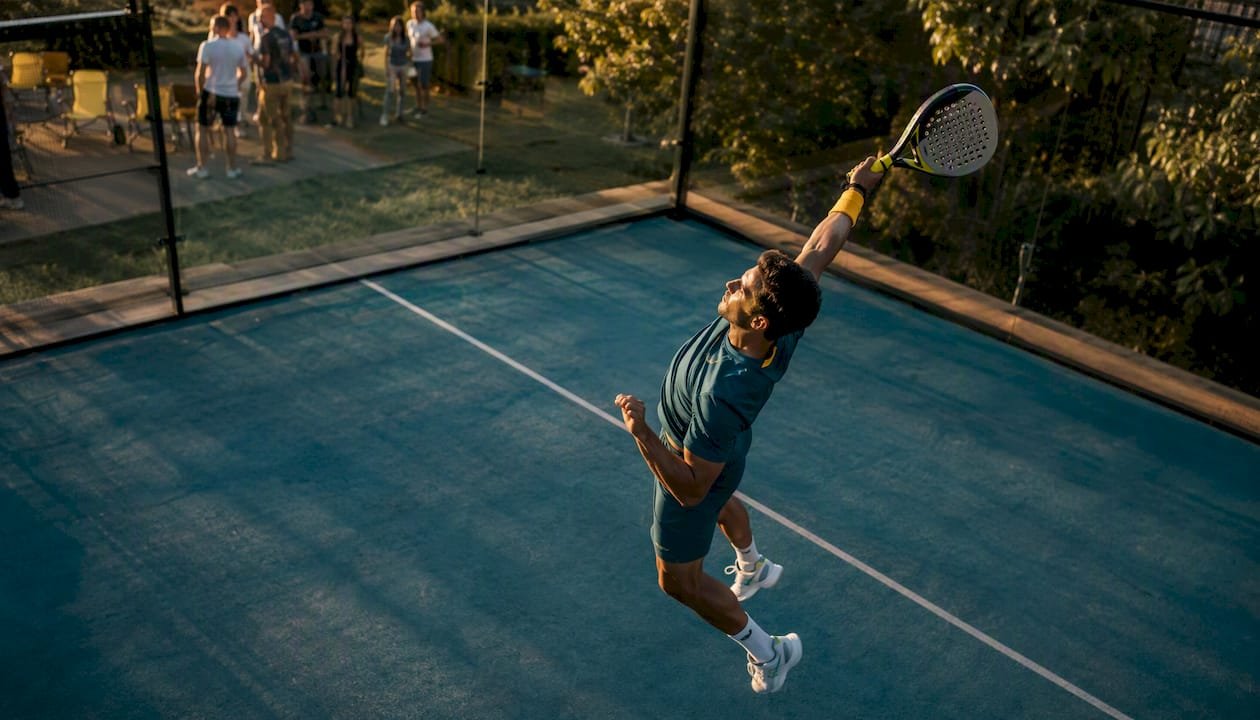
Head’s Arturo Coello signature frame is the closest thing on this list to a “plug and play” tournament racket. The sweet spot sits high on the face, which is exactly where advanced players make contact on finishing volleys and overhead smashes. Power is consistent rather than explosive — you get the same energy return on ball 50 of a session as on ball 1, which matters when you are playing three sets. The anti-vibration system is less aggressive than VibraDrive but sufficient for most players practicing two to three hours daily.
Pros: Consistent power across a full session, high sweet spot placement, reliable tournament feel.
Cons: Less raw power ceiling than the Hack 04; not ideal for players who want tunable balance.
Best for: Tournament-level attackers who prioritize tempo and consistency over peak smash power.
U.S. availability: Available at Padelhip; typical price $230–$270.
Bullpadel Vertex series (Vertex 04 / Vertex 05 Geo)
Specs: Diamond shape, 365–375 g, head-heavy (adjustable via CustomWeight), Xtend Carbon 12K face, MultiEva multi-density core, VibraDrive, 38 mm beam.
The Vertex 05 Geo adds GeometricCore and AirPower aerodynamics to the already-strong Vertex 04 platform. In practice, the GeometricCore changes how the ball sits in the sweet spot on defensive slices — there is slightly more dwell time, which helps with placement. The MultiEva core is the real differentiator: different density zones mean the racket plays softer on low defensive shots and firmer on high finishing volleys, which is a meaningful advantage in long rallies.
Pros: CustomWeight tuning, MultiEva core adapts to shot type, durable Xtend Carbon face.
Cons: 12K face is less aggressive than 18K options for pure power; Vertex 05 Geo commands a price premium.
Best for: Advanced attackers who want tunable balance and a durable frame for heavy practice loads.
U.S. availability: Available at Padelhip; typical price $210–$260.
Babolat Air Viper / Air Vert
Specs: Teardrop shape, 340–360 g, even to head-light balance, carbon fiber face, EVA Soft/Medium core, lightweight anti-vibration construction.
The lightest frames on this list by a meaningful margin. At 340–360 g, the Air Viper and Air Vert swing faster than any diamond on the shortlist, which translates directly to reaction speed at the net. The teardrop shape moves the sweet spot toward the center of the face, giving you more forgiveness on defensive returns than a diamond provides. The trade-off is obvious: you give up the raw smash power of an 18K diamond. For players who win points through placement and speed rather than pace, that trade is worth it.
Pros: Fastest swing speed on the list, forgiving teardrop sweet spot, comfortable for long sessions.
Cons: Less power ceiling than diamond alternatives; not suited for players who rely on heavy smashes.
Best for: Net specialists and players who prioritize quick reaction volleys and placement over raw power.
U.S. availability: Available at Padelhip; typical price $180–$220.
Royal Padel EFE Extreme (2026)
Specs: Diamond shape, 360–375 g, head-heavy, carbon fiber face, EVA Hard core, reinforced carbon frame.
The Royal Padel EFE Extreme is the value pick on this list. It delivers a genuine high-power diamond feel — hard EVA core, reinforced carbon face, head-heavy balance — at a price point that undercuts most of the competition by $40–$60. The frame lacks the tunable weight systems of the Nox or Bullpadel options, and the vibration dampening is basic compared to VibraDrive. But if you want a no-frills power diamond that performs at an advanced level without the premium price tag, this is where to start.
Pros: Strong power output, carbon fiber construction, competitive price for the spec level.
Cons: No adjustable balance system; basic vibration dampening.
Best for: Advanced and tournament players who want maximum power output at a lower price point.
U.S. availability: Available at Padelhip; typical price $180–$220.
Adidas Metalbone (2026)
Specs: Diamond shape, 360–375 g, head-heavy, carbon fiber face, EVA Medium/Hard core, anti-shock system.
The Metalbone’s 2026 update focused specifically on power and stiffness tuning. Adidas tightened the sweet spot profile to favor aggressive net finishers who generate their own pace — the frame rewards players who swing through the ball rather than relying on the racket’s rebound. The anti-shock system is competent without being exceptional. Where the Metalbone stands out is in feel consistency: the power output is predictable across different shot types, which advanced players who practice pattern-based drilling will appreciate.
Pros: Predictable power output, aggressive sweet spot for net attackers, updated 2026 stiffness profile.
Cons: Tight sweet spot penalizes off-center contact; no tunable weight system.
Best for: Advanced net attackers who generate their own pace and want consistent power delivery.
U.S. availability: Available through specialty retailers; typical price $230–$280.
Oxdog Ultimate Pro+
Specs: Diamond to teardrop shape, 360–375 g, even balance, carbon fiber face, EVA Medium core, balanced construction with durability focus.
The Oxdog Ultimate Pro+ is the all-rounder on this list. Even balance means it does not commit fully to power or control — instead, it gives advanced players a platform to express both. The construction prioritizes durability, which matters for players who practice daily on abrasive artificial grass courts. It is not the most exciting racket on paper, but players who want one frame that handles power rallies, defensive exchanges, and net play without a significant weakness will find it reliable.
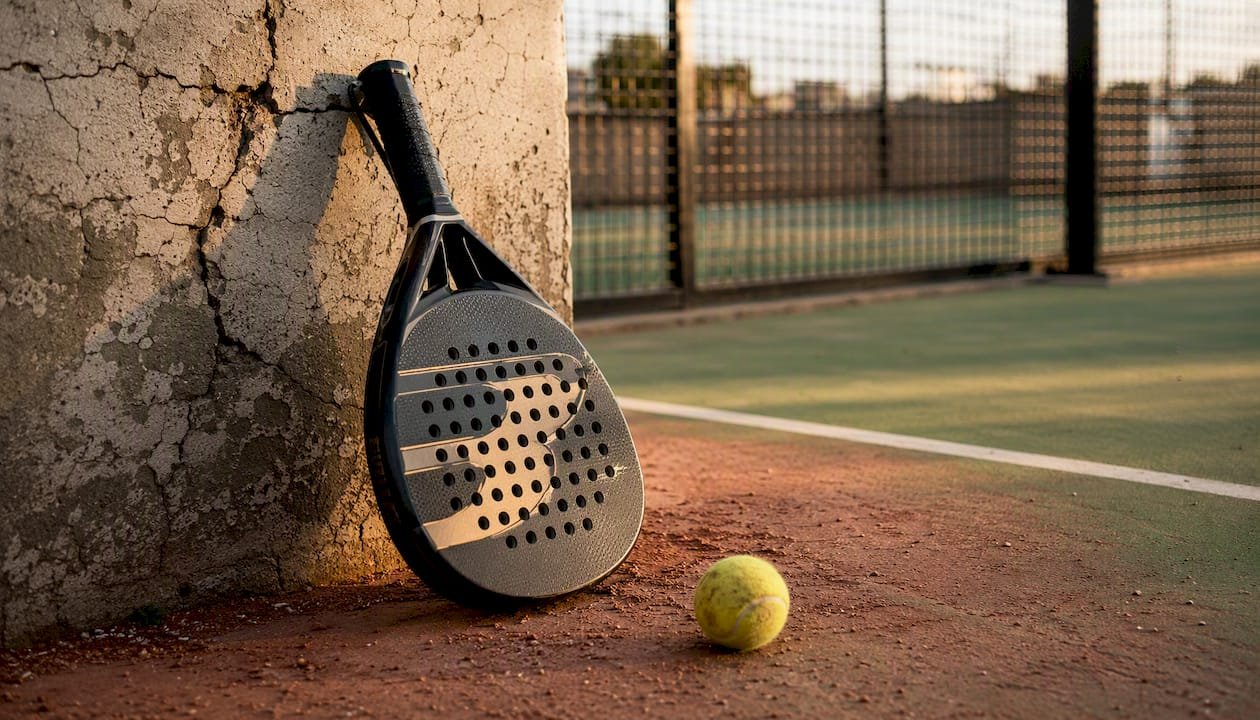
Pros: Balanced feel, durable construction, versatile across play styles.
Cons: Does not excel in any single dimension; less spin potential than textured-face alternatives.
Best for: Advanced all-rounders who want one racket that covers every situation.
U.S. availability: Available through specialty retailers; typical price $190–$240.
How do you choose the right advanced padel racket?
Advanced players are not choosing between “good” and “bad” rackets. Every model on this list performs at a high level. The real question is which technical profile matches your game.
Tunability first. If you play multiple formats (singles, doubles, practice, tournament), a racket with an adjustable weight or balance system — the Nox AT10’s Weight Balance or Bullpadel’s CustomWeight — gives you meaningful flexibility. Players who use a fixed-balance frame are locked into one feel regardless of context.
Carbon face composition. The difference between 12K and 18K carbon is not just marketing. 18K carbon produces a denser fiber pattern that generates a firmer, more consistent response at high impact speeds. Combined with a hard EVA core, it yields explosive ball exit — but it requires precise technique. If your contact point varies, a 12K face is more forgiving and still performs at an advanced level.
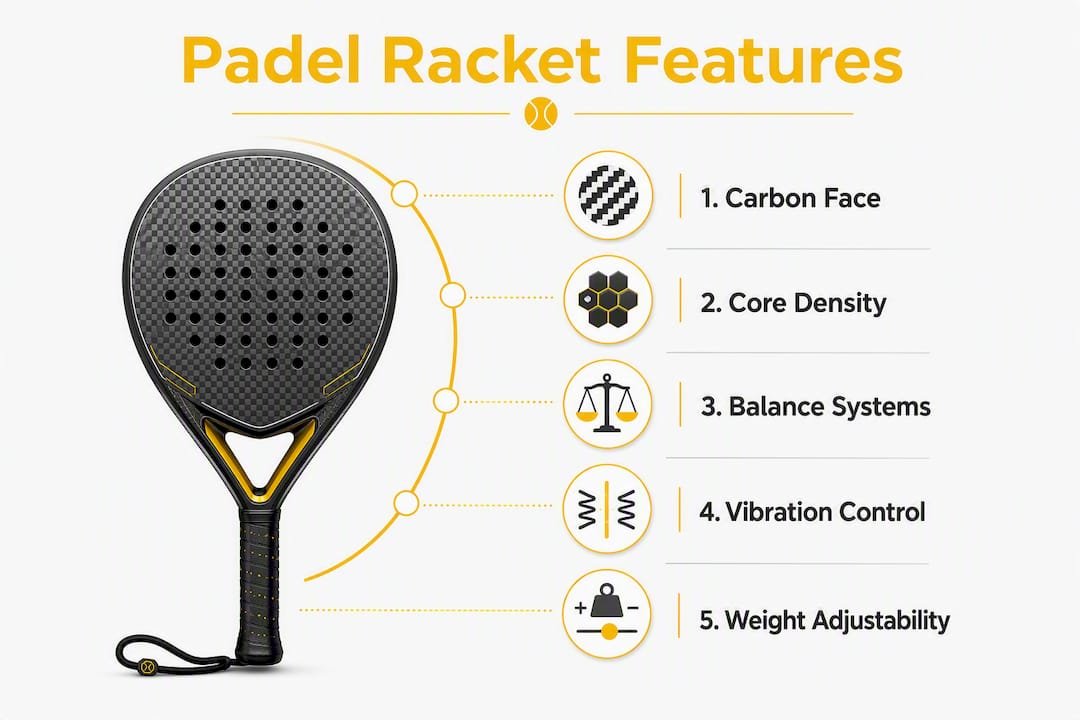
Core density and ball exit. Hard EVA cores produce faster ball exit and suit power attackers. Softer or multi-density cores (like MultiEva) give more dwell time, which helps with spin and placement. Neither is universally better — it depends on whether you win points through pace or precision.
Vibration and arm health. Top-level manufacturers integrate vibration-reduction systems because advanced players often practice multiple hours daily. VibraDrive (Bullpadel), DCS (Nox), and similar systems are not optional extras at this level — they are injury-prevention tools. If you have had any history of elbow or wrist discomfort, prioritize a racket with a dedicated dampening system and a medium-density core over a hard 18K setup.
The 5-minute on-court test. When you demo a racket, hit in this order: serve returns (check swing speed and timing), volleys (feel the sweet spot location), smashes (assess power ceiling and vibration), and defensive slices (note how the frame handles off-center contact). If any one of those four feels wrong, the racket is not the right match regardless of the spec sheet.
Pro Tip: When testing tunable weight systems, change only one variable at a time. Move 2 g from the handle to the head, then hit 20–30 balls before forming an opinion. Changing multiple weights simultaneously makes it impossible to isolate what changed the feel.
Questions to ask before buying: What is the exact measured weight of this specific unit (not the listed range)? What is the return window for demoing? Does the warranty cover frame cracks from normal play? Is this a 100% authentic unit with manufacturer documentation?
How we chose and tested these rackets
-
Tester profile. Serena evaluated each model with input from advanced-level players across right- and left-handed grips, using a standard test weight of 365 g as the baseline for comparison.
-
Testing conditions. All models were tested on artificial grass courts under consistent conditions. Each racket received a minimum of two full sessions before scoring to allow for muscle memory calibration.
-
Rating dimensions. Six dimensions were scored per model:
- Power: ball exit speed on smashes and flat drives
- Control: placement accuracy on volleys and defensive returns
- Maneuverability: swing speed and ease of repositioning
- Sweet spot size: forgiveness on off-center contact
- Durability: frame and face integrity after repeated sessions
- Comfort/vibration response: arm feel across a full session
-
Scoring weight. Power and control each carried the most weight for this advanced-player shortlist, followed by comfort (given the injury-prevention priority at this level), then maneuverability, sweet spot, and durability.
-
U.S. availability check. Each model was verified for availability through U.S.-accessible retailers or international stores shipping to the U.S., with Padelhip confirmed as a source for several models.
What racket technology actually matters for advanced players?
The gap between a $150 intermediate racket and a $250 advanced frame is not just carbon fiber. It is the specific combination of technologies that let advanced players push their technique further without paying for it physically.
Racket Balance Systems (RBS). The Weight Balance counterweight system on the Nox AT10 is the clearest example of RBS in the 2026 market. Swapping 2 g and 4 g pieces changes both the static balance point and the dynamic swing inertia — small adjustments that materially affect swing speed and perceived control. Elite-level gear is increasingly tunable: one racket can serve as multiple tuning profiles across a season.
Dynamic Composite Structure (DCS). DCS applies additional frame material up to 4 cm into the face to even out hardness differences between the frame edge and the hitting surface. The practical result is fewer fiber breakages on off-center hits — a durability advantage that matters for players who practice daily.
Dual Spin and 3D textured surfaces. Rough or textured carbon faces grab the ball differently than smooth carbon. The Dual Spin surface on the AT10 generates more friction on slice and kick serves. For spin specialists, this is a genuine performance differentiator, not a cosmetic feature.
Multi-density EVA cores. The MultiEva core in the Bullpadel Vertex series uses different density zones across the hitting surface. The result is a racket that plays softer on low defensive shots and firmer on high finishing volleys within the same frame. Single-density hard EVA cores produce more consistent power but less adaptability.
Vibration-dampening systems. Advanced players often practice multiple hours daily, and the cumulative vibration load from rigid 18K carbon frames is a real injury risk. VibraDrive (Bullpadel), DCS (Nox), and dedicated anti-vibration systems in professional-grade rackets are specifically designed to reduce chronic arm strain. A racket without meaningful dampening is a liability for anyone training at volume.
Pro Tip: Use adjustable balance settings conservatively during match play — stick to a setting you have already calibrated in practice. Save balance experiments for training sessions, and log each setting with a note on how it affected your smash timing and defensive slice feel. After 20–30 minutes per setting, you will have a reliable personal reference.
Which advanced racket fits your play style?
Power attacker (net finisher). The Bullpadel Hack 04 and Adidas Metalbone are the clearest matches. Both are head-heavy diamonds with hard EVA cores built for players who end points with smashes. The Hack 04 edges ahead on raw power output; the Metalbone offers more predictable delivery across shot types. For U.S. buyers, the Hack 04 is available through Tennis Warehouse Europe with U.S. shipping; the Metalbone through specialty retailers at $230–$280.
- Tuning tip: add weight to the head (2–4 g) to increase smash power, but test the effect on your serve return timing before committing.
Control/placement player (defender or baseliner). The Head Extreme Pro and Oxdog Ultimate Pro+ are the right starting points. The Head frame’s high sweet spot placement rewards consistent contact; the Oxdog’s even balance suits players who need to cover the full court without committing to a power-heavy setup.
- Tuning tip: if using the Vertex series, shift weight toward the handle to soften the head-heavy feel and improve defensive slice control.
Spin specialist. The Nox AT10 Genius 18K is the obvious answer, specifically because of the Dual Spin surface. No other racket on this list generates comparable friction on slice and kick shots. The 12K variant is a reasonable alternative if the 18K’s stiffness feels too demanding.
- Tuning tip: use the Weight Balance system to add slight head weight for more spin on serves, then shift neutral for volleys.
All-rounder. The Bullpadel Vertex series and Oxdog Ultimate Pro+ both serve this profile. The Vertex gives you more tuning range; the Oxdog gives you more durability and a simpler setup. For players who want one racket across all formats, the Vertex’s CustomWeight system makes it the more adaptable long-term investment.
- U.S. buy tip: the Bullpadel Vertex Advance 26 is available directly at Padelhip, which simplifies the purchase and return process for U.S. buyers.
Maneuverability-first (net reactor). The Babolat Air Viper / Air Vert is the only teardrop on this shortlist and the lightest by a meaningful margin. If your game is built on fast hands and placement rather than pace, this is the frame. Available at Padelhip at $180–$220.
What is the final verdict and how do you buy in the U.S.?
The Nox AT10 Genius 18K is the best overall advanced padel racket for 2026. The combination of tunable balance, Dual Spin surface, and 18K carbon covers more advanced-player needs than any single competitor. If pure power is the priority and budget is a factor, the Royal Padel EFE Extreme delivers a genuine diamond-power feel at $180–$220 without the premium of the Nox or Bullpadel flagships.
Before you check out, confirm:
- Exact measured weight of your specific unit (not the listed range)
- Return or demo window (Padelhip offers easy returns)
- Frame warranty terms and what voids coverage
- Authenticity guarantee (100% authentic products at Padelhip)
- Shipping timeline and U.S. delivery expectations
Price ranges by category (USD):
- Power diamonds (Hack 04, Metalbone, AT10 18K) fall within a premium price range
- Control/all-round frames like Head Extreme Pro and Oxdog Ultimate Pro+ are priced in the mid to high range
- Value power diamonds such as Royal Padel EFE Extreme come at a relatively lower price point
- Maneuverability-focused frames like Babolat Air Viper / Air Vert are priced moderately
Stat to know: Power-oriented models on this list consistently spec at 365–375 g with a 38 mm beam — the standard advanced-player power-diamond profile. Frames outside that range (lighter teardrop models like the Babolat Air Vert) are purpose-built for maneuverability, not power.
Do advanced padel rackets need stringing or surface treatment?
Padel rackets are not strung — the hitting surface is a solid foam core bonded to a carbon or fiberglass face, not a string bed. There is no stringing to maintain. What advanced players do need to manage is the face surface itself.
Surface treatments. Some advanced players apply a thin layer of grip spray or specialized padel wax to textured carbon faces (like the Dual Spin surface on the AT10) to preserve the surface texture and extend spin performance. This is not universal practice, but players who rely heavily on slice and kick serves notice a difference as the texture wears. Check the manufacturer’s guidance before applying any product — some coatings can void warranty coverage.
Protective edge tape. The frame edge is the most vulnerable part of any advanced racket. Applying protective edge tape (available from most padel retailers) before the first session prevents chips and cracks from court contact. Replace it when it shows wear rather than waiting for frame damage.
Grip replacement. Overgrips wear faster than players expect at advanced play intensity. Replace the overgrip every 8–12 hours of play; replace the base grip when it loses tackiness or shows compression. A worn grip changes your hand position subtly and affects shot consistency more than most players realize.
How do you keep an advanced racket in top condition?
Advanced rackets are more sensitive to misuse than intermediate frames because the stiffer carbon construction and harder cores leave less margin for error — in play and in storage.
Storage. Never leave a racket in a hot car or direct sunlight. Carbon fiber and EVA foam both degrade faster under heat cycling. A padel bag with thermal lining is the simplest protection.
Post-session wipe-down. Sweat and court dust accumulate on the face and frame after every session. Wipe the face with a damp cloth and dry it immediately. Abrasive cleaners scratch the carbon surface and accelerate texture wear on spin-optimized faces.
Frame inspection. After every session, run your fingers along the frame edge and check for micro-cracks, especially near the throat and the top of the frame where smash impact concentrates. Catching a hairline crack early means you can adjust your play before the frame fails completely.
Avoid extreme temperature changes. Moving a cold racket directly into a warm, humid environment causes condensation inside the core. Let the racket reach room temperature gradually before playing.
When to replace. A frame that has developed a crack in the carbon face or shows delamination between the face and the foam core is no longer structurally sound. Playing with a compromised frame risks injury and produces inconsistent ball response. At the advanced level, a damaged racket is not a cost-saving measure — it is a liability.
Key Takeaways
The Nox AT10 Genius 18K is the best overall advanced padel racket in 2026, combining tunable balance, Dual Spin surface, and 18K carbon in one frame that covers power, spin, and adaptability for serious players.
| Point | Details |
|---|---|
| Prioritize tunability | Rackets with adjustable weight systems (Nox AT10, Bullpadel Vertex) let you adapt balance for match vs. practice without buying a second frame. |
| Match carbon type to technique | 18K carbon rewards precise, high-speed technique; 12K is more forgiving and suits players with variable contact points. |
| Vibration tech is injury prevention | At advanced practice volumes, VibraDrive, DCS, and similar systems reduce chronic arm strain — not optional extras. |
| Power vs. forgiveness trade-off | Hard EVA cores and head-heavy diamonds maximize smash output but penalize off-center contact; softer or multi-density cores balance both. |
| Padelhip for U.S. buyers | Padelhip stocks the Head Extreme Pro, Bullpadel Vertex Advance 26, Babolat Air Vert, and Royal Padel EFE Extreme with easy returns and worldwide shipping. |
The racket market rewards patience, not impulse
The conventional wisdom in padel gear is to buy the racket your favorite pro uses. Agustín Tapia plays the AT10 Genius, so the AT10 must be the answer. That logic is not wrong — the AT10 is genuinely excellent — but it skips the more important question: does your technique actually justify an 18K carbon face?
18K carbon is unforgiving. It amplifies good technique and punishes inconsistency. A player who makes clean contact 80% of the time will love it. A player at 60% clean contact will fight the racket every session and blame their form when the real problem is the mismatch between the frame’s demands and their current skill level.
The smarter move for most advanced players is to start with a 12K or hybrid face and a medium-density core, build consistency, and then step up to 18K when the frame stops being the limiting factor. The Bullpadel Vertex series is the right bridge: tunable balance, MultiEva core, and a 12K Xtend Carbon face that performs at an advanced level without the unforgiving feedback of a full 18K setup.
The other thing the market undersells is vibration management. Players who practice two or more hours daily on hard 18K frames without adequate dampening are accumulating arm stress that shows up as elbow or wrist discomfort months later. VibraDrive and DCS are not marketing features. They are the reason advanced players can sustain high-volume training without chronic injury.
Buy the racket that matches where your technique is now, not where you want it to be in six months. You can always step up.
Shop the recommended rackets at Padelhip
Padelhip stocks several of the rackets on this shortlist with 100% authenticity guarantees, easy returns, and worldwide shipping from Spain — including delivery to the U.S. The Head Extreme Pro (Arturo Coello), Bullpadel Vertex Advance 26, Babolat Air Vert, and Royal Padel EFE Extreme (2026) all have dedicated product pages with current pricing and stock status. If you are deciding between two models, Padelhip’s return policy gives you the flexibility to order, demo on court, and return the frame that does not fit your game.
The difference between buying from a specialist padel retailer and a general sports marketplace is authenticity verification and post-purchase support. Padelhip’s product curation means every racket listed is a genuine manufacturer unit, not a gray-market import. For U.S. buyers who cannot walk into a local padel shop and demo frames in person, that guarantee matters. Shop the full advanced racket range at Padelhip and use the return window as your on-court demo period.
Useful sources and product pages
Verify specs, warranties, and current stock directly from manufacturer and retailer pages before purchasing. Measured weights can vary by unit within the listed range, and stock changes frequently.
- Nox AT10 Genius 18K Alum 2026 — official NOX product page — Weight Balance system specs, Dual Spin surface details, DCS frame reinforcement documentation
- Bullpadel Hack 04 2026 — Tennis Warehouse Europe — TriCarbon 18K specs, VibraDrive details, measured weight range
- Bullpadel Vertex 05 Geo Premier Padel 2026 — Tennis Warehouse Europe — GeometricCore, AirPower aerodynamics, beam and weight specs
- Bullpadel Vertex 04 Review — SimplePadel — CustomWeight system analysis, MultiEva core breakdown, tunable balance testing notes
- Royal Padel EFE Extreme 2026 — Padelhip product page — U.S. availability, EVA core and carbon face specs
- Head Extreme Pro Arturo Coello — Padelhip product page — current stock, shipping options to the U.S.
- Bullpadel Vertex Advance 26 — Padelhip product page — Vertex series availability and pricing at Padelhip
- Babolat Air Vert — Padelhip product page — lightweight carbon teardrop specs and U.S. availability
- Manufacturer warranty documentation: check each brand’s official site for frame warranty terms; most cover manufacturing defects for 12 months but exclude damage from court contact or improper storage. Padelhip’s authenticity guarantee supports warranty claims by confirming the unit is a genuine manufacturer product.
Recommended
- Head Speed Pro X Padel Racket | Pro-Level Carbon Power & Control Racket for Advanced Players 2026 – Your online Padel store- Padel Hip-Premier padel shop
- HEAD Radical Pro 2026 Padel Racket – High Stability Advanced Control Racquet for Intermediate and Competitive Players with Carbon Frame – Your online Padel store- Padel Hip-Premier padel shop
- Adidas Arrow Hit Hexagon Cup 2026 Padel Racket | Diamond Shape Carbon Power Racket for Advanced & Competitive Players – Your online Padel store- Padel Hip-Premier padel shop
- Head Extreme Pro Arturo Coello Padel Racket | Pro-Level Diamond Carbon Power Racket for Advanced & Competitive Players 2026 – Your online Padel store- Padel Hip-Premier padel shop